






The foundations of Australia’s housing boom are being tested

For years, Australian residential property has been viewed as a one-way bet. Mention the possibility of falling house prices and you’re often met with disbelief. Population growth, constrained housing supply and a deeply ingrained belief that property always goes up have combined to create one of the most expensive housing markets in the developed world.
But markets are ultimately driven by fundamentals, and those fundamentals are becoming increasingly difficult to ignore.
A market built on debt
Australian property prices are some of the most expensive in the world, and households are among the most indebted in the world. Household debt is around 112% of GDP and 67% in the United States. For context, household debt in the US was circa 100% in 2007.
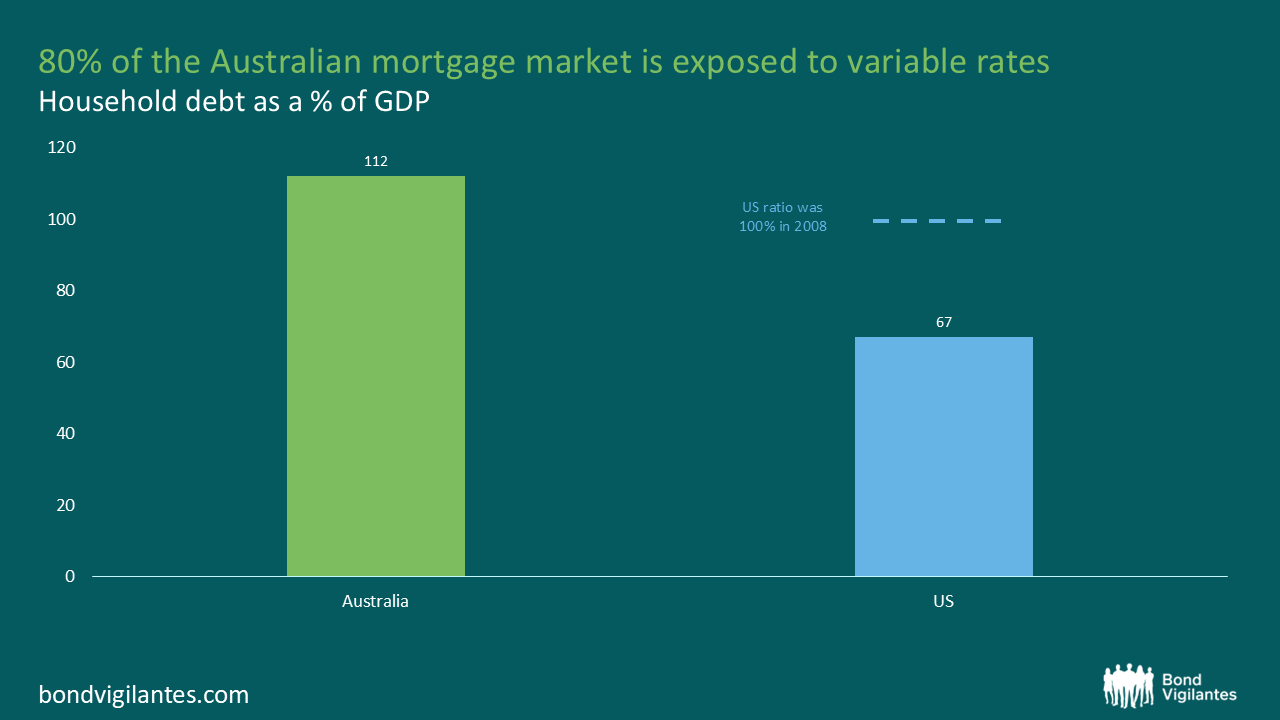
Source: M&G, Bloomberg, 31 December 2026 (latest available data).
Now I’m not saying the Australian housing market is going to experience what the US did in 2008 as the market is different. Lending is stricter, there is full recourse and the market continues to be supported by strong migration. However, this is a weak starting point and leaves the market more exposed to rate moves and with less room to take on further debt. As we have mentioned in previous blogs – at some point debt matters.
High debt is not necessarily a problem while borrowing costs remain low. However, when rates rise, highly indebted households have less disposable income, reducing consumption and increasing financial stress. At the same time, fewer prospective buyers can afford to borrow the amounts needed to support current property valuations. That combination has historically placed downward pressure on house prices.
Unlike markets such as the United States, where 30-year fixed-rate mortgages are common, Australia’s mortgage market is heavily exposed to variable interest rates or short-term fixed loans that quickly roll onto prevailing market rates. This means monetary policy feeds through to households far more rapidly.
The Reserve Bank of Australia has limited room for accommodation
The Reserve Bank of Australia (RBA) faces a difficult balancing act. Inflation remains a key concern, and while economic growth has moderated, the Bank’s primary objective is price stability. As long as inflation remains stubbornly above target, policymakers are likely to maintain a restrictive stance on interest rates rather than provide support to asset prices.
Higher interest rates are precisely the environment that highly leveraged housing markets dislike. For years, falling interest rates acted as a tailwind for property prices. Today, that structural support has disappeared and, has become a headwind.
Meanwhile, consumer confidence remains fragile alongside an economy losing momentum. Housing doesn’t exist in isolation. It is ultimately a function of household confidence, income expectations and people’s willingness to take on debt. Consumer confidence in Australia remains at historically subdued levels, reflecting the pressure that higher mortgage repayments, elevated living costs and persistent inflation have placed on household finances. When households become more cautious, they delay major purchases, save more and become less willing to stretch themselves financially.
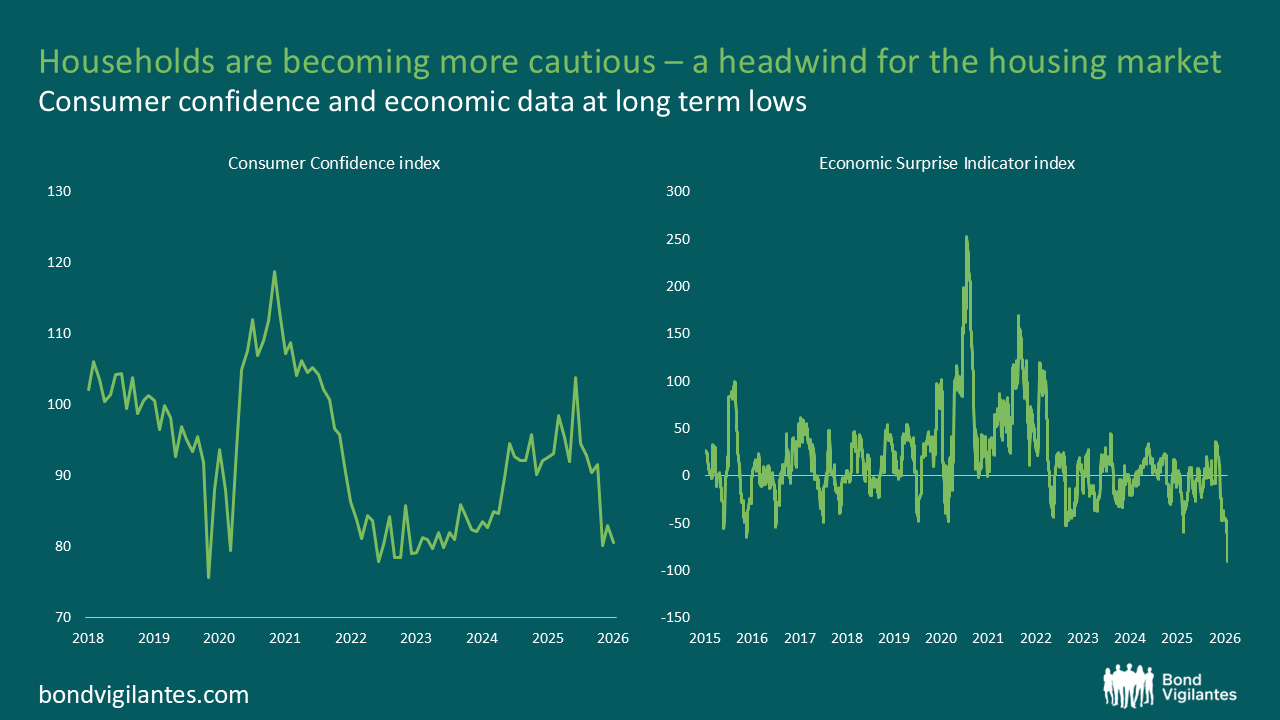
Source: M&G, Bloomberg, 30 June 2026.
Another indicator worth watching is Australia’s Economic Surprise Index, which measures whether economic data is coming in above or below economists’ expectations. The index has fallen to its weakest levels in around a decade, suggesting the economy is consistently underperforming relative to expectations. While no single economic indicator predicts house prices, weakening economic momentum rarely provides a supportive backdrop for an already expensive housing market. Slowing growth, subdued consumer sentiment and restrictive monetary policy are not conditions typically associated with rising property valuations.
What has changed? Tax incentives.
Property investors have long benefited from Australia’s favourable tax treatment, particularly through negative gearing and capital gains tax concessions. Recent changes have made the investment landscape considerably less attractive than it has been historically. As these incentives become less generous, the after-tax return from residential property declines, reducing the appeal of paying increasingly stretched valuations in anticipation of future capital gains.
When investment demand softens, one of the key pillars supporting house prices begins to weaken. Now, these changes are not shock and awe, but I do think they are meaningful.
- Negative gearing: if an investor received $35,000 rent and had $50,000 expenses, the 15k loss could be offset against income tax. This will no longer be the case.
- Capital gains tax: Previously investors only have to pay tax on 50% of any capital gain. This has now been changed to be charged on the full capital gain, but after an inflation adjustment.
Both of these property price supportive measures have been removed for any existing housing stock, but remains for new builds. It must also be noted that all property has been grandfathered, meaning you still enjoy the old benefits for any purchases made prior to July 2026. These measures have been put in place to address the huge supply/demand imbalance by dampening demand for existing housing stock. I just worry that the regulators don’t realise how supportive these measures have been over the years to valuations. My concern is not that this triggers an abrupt crisis, but rather a period of weaker house prices and gradual household deleveraging. Given the sensitivity of Australian households to mortgage rates, this also makes it harder for the RBA to hike aggressively without risking a broader hit to consumption and the wider economy.
The value of investments will fluctuate, which will cause prices to fall as well as rise and you may not get back the original amount you invested. Past performance is not a guide to future performance.