






Same Google, but cheaper: a risk worth taking in US credit

Take two bonds from one issuer, with identical seniority, rating, and credit risk. Yet the credit spread, the portion of the yield above the risk-free rate that compensates you for taking that risk, is meaningfully wider versus government bonds than it is versus interest rate swaps – wide enough for it to be worth paying attention to.
This is particularly relevant for strategies that aim to isolate credit risk and hedge away interest rate exposure. In those strategies, the instrument used for interest rate hedging has a direct bearing on how much value is available in credit markets.
That is the situation in US credit today. Alphabet, the AA rated parent of Google, currently trades at around 90 basis points over US Treasuries at the 20-year point. Treasuries are the market standard risk-free rate in US fixed income, and on that measure the credit spread of a business of that quality looks expensive: barely any reward for the risk. Measure the same bond against interest rate swaps and the spread jumps to around 150 basis points. The bond’s yield has not changed, but over swaps this AA name pays you more like a BBB.
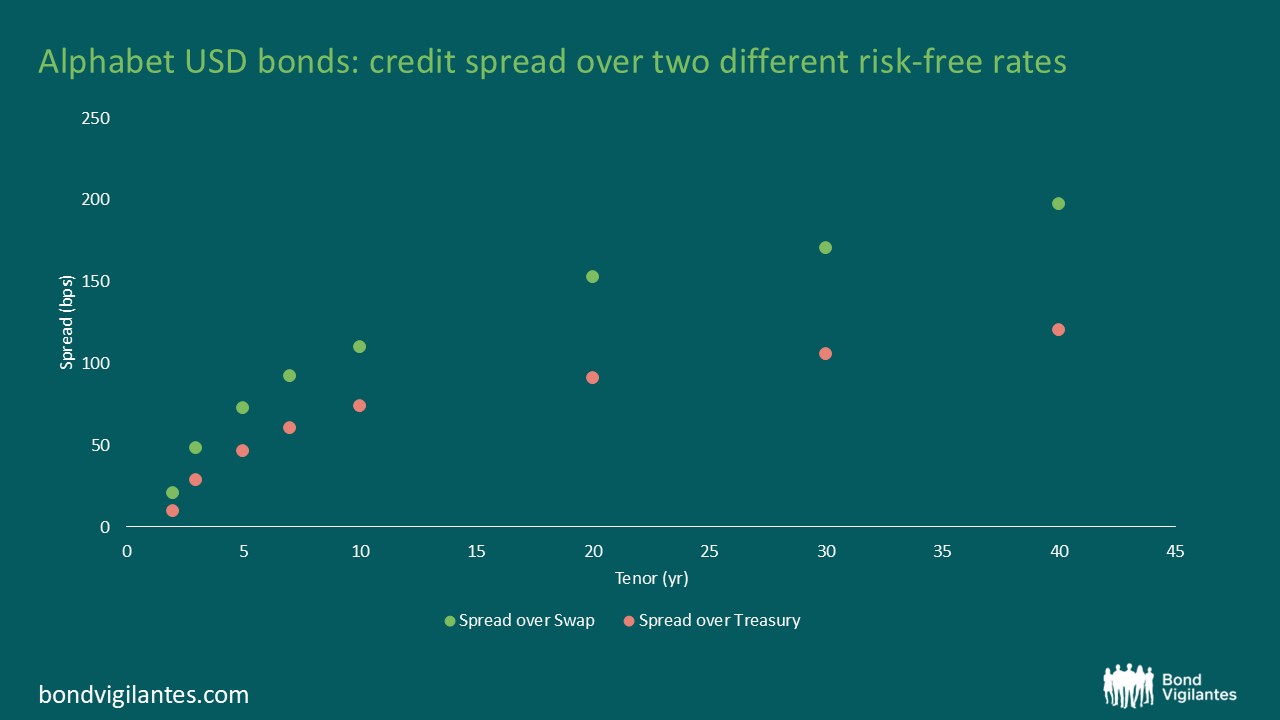
Source: Bloomberg, as at 25 September 2026.
This is not confined to one bond. We see it across the US market, and it has changed how we hedge dollar duration in our credit only strategies.
Two hedging instruments, one choice.
Back in August, we replaced part of the US futures duration hedge for the long part of the dollar curve in some of our funds with interest rate swaps. The choice of hedge determines which spread we retain and therefore how much value we see in the bond. Hedge with Treasury futures and we keep the spread over Treasuries. Hedge with swaps and we keep the spread over swaps.
Both are legitimate hedging instruments, but neither is a perfect risk-free rate. The question is which one is more distorted today. In the US, the premium bolted onto the Treasury yield is unusually large: much of the swap curve trades well below government bonds of the same maturity, a negative swap spread, which upends the usual logic that the safest borrower should yield less than the bank-based swap rate, not more. Concerns over government budget deficits and the relentless supply of Treasuries needed to fund them are pushing government yields up, particularly further out on the curve.
We think the swap curve is currently the better approximation of the dollar risk free rate. Part of what looks like a tight credit spread is simply the elevated Treasury yield making it look that way.
Putting it to work
In practice, this means buying the same credit risk in the market that rewards us better. In August, at the 20-year point Google traded at roughly 110 basis points over the relevant government bonds in euros, and at roughly 100 basis points over Treasuries in dollars, so on the surface the euro bond looked slightly more attractive. But the euro market lacks the dollar market’s dislocation between bonds and swaps, so once the dollar bond is hedged back with swaps it moved closer to 170 over swaps. We sold euro bonds, bought dollar ones, and captured a higher spread for no additional credit risk.
We have found similar opportunities beyond Google and used them to improve the overall quality of the portfolio without giving up much spread: switching out of Aegon and Rothesay, and into Allianz and Munich Re.
These are not dramatic trades, but they allow us to improve portfolio quality without sacrificing much income.
The risk we are taking
If measuring credit against swaps currently hands us an extra 40 to 70 basis points, we should be clear about what we take on in return. Because dollar bonds are conventionally priced over Treasuries, we now carry the risk of the swap spread itself.
The risk becomes clear if US Treasuries sell off. If the bond’s credit spread over Treasuries is unchanged, its total yield rises in step and its price falls. Our swap hedge is meant to cushion that – we want to be exposed only to credit risk – but if swap rates do not follow the Treasuries sell-off, the hedge fails to keep pace. The bond’s spread over swaps widens, and the fund is left with a mark-to-market loss.
We think this is a risk worth taking; we are not entering at the average but at the extreme. US swap spreads are already unusually negative by any historical measure. Before the financial crisis they were positive, around 60 basis points at 10 years. Today the 10 year sits at around -40 and the 30 year at -70, at or beyond the wide end of even the post 2008 experience, even after allowing for the approximately 25 basis points attributable to the switch from LIBOR to SOFR in the early 2020s. At these levels, we believe the balance of risk favours some normalisation towards zero rather than a substantial further widening.
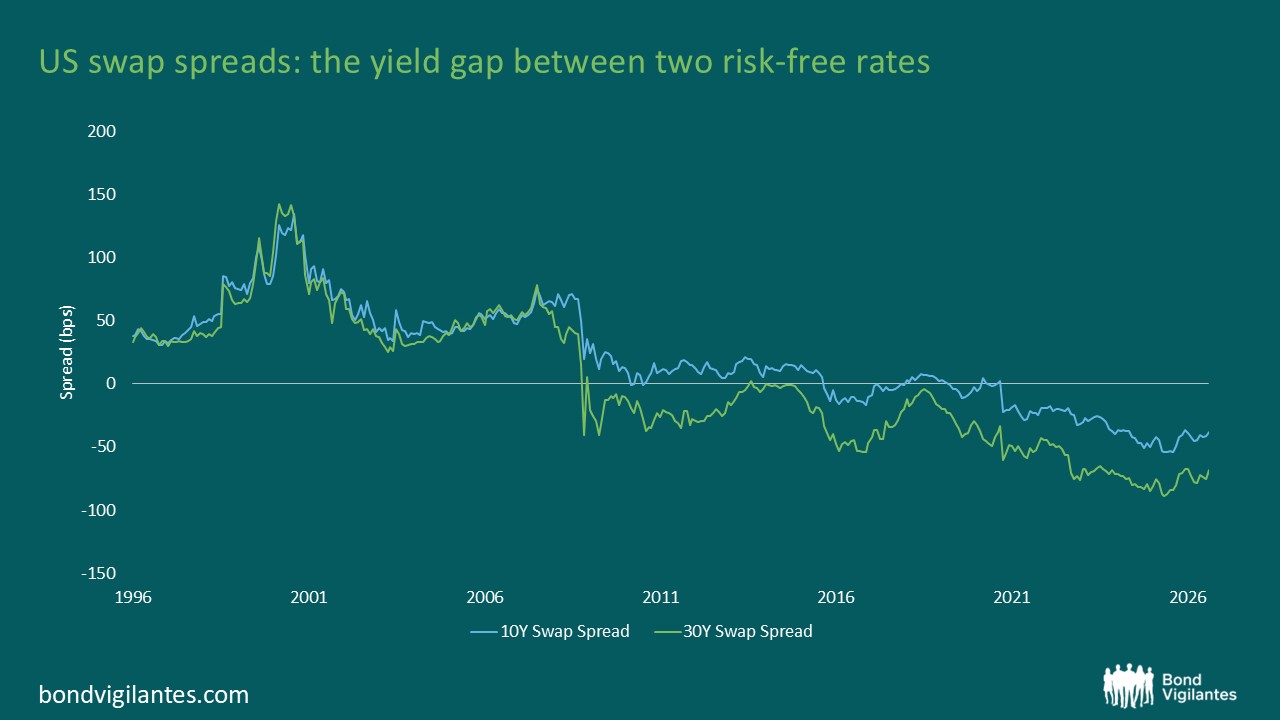
Source: Bloomberg, data as at 25th September 2026.
Not free, but worth the risk.
None of this is free. But we believe the swap rate is currently the better tool for hedging the rates risk in our portfolios, and that the additional 40 to 70 basis points represents generous compensation for a risk that is well understood and largely disconnected from the credit we actually own. We may be early, and swap spreads could move further into negative territory. But these are the valuation calls we are paid to take.
The value of investments will fluctuate, which will cause prices to fall as well as rise and you may not get back the original amount you invested. Past performance is not a guide to future performance.