






The Great Repression

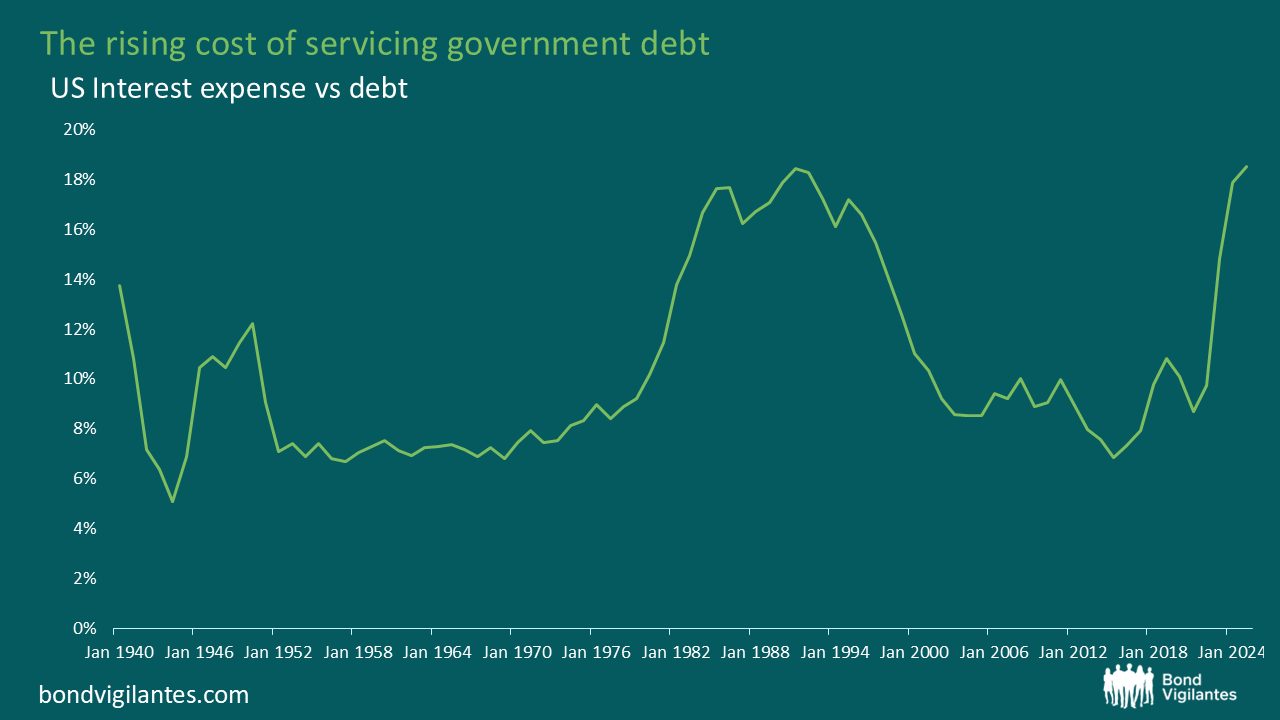
Across much of the developed world, governments are spending an increasing share of their tax revenues servicing debt.
Source: Federal Reserve Economic Data
The era when debt could rise indefinitely while interest costs remained low appears to be ending.
Source: Bloomberg
The second chart hints at how this problem may be confronted.
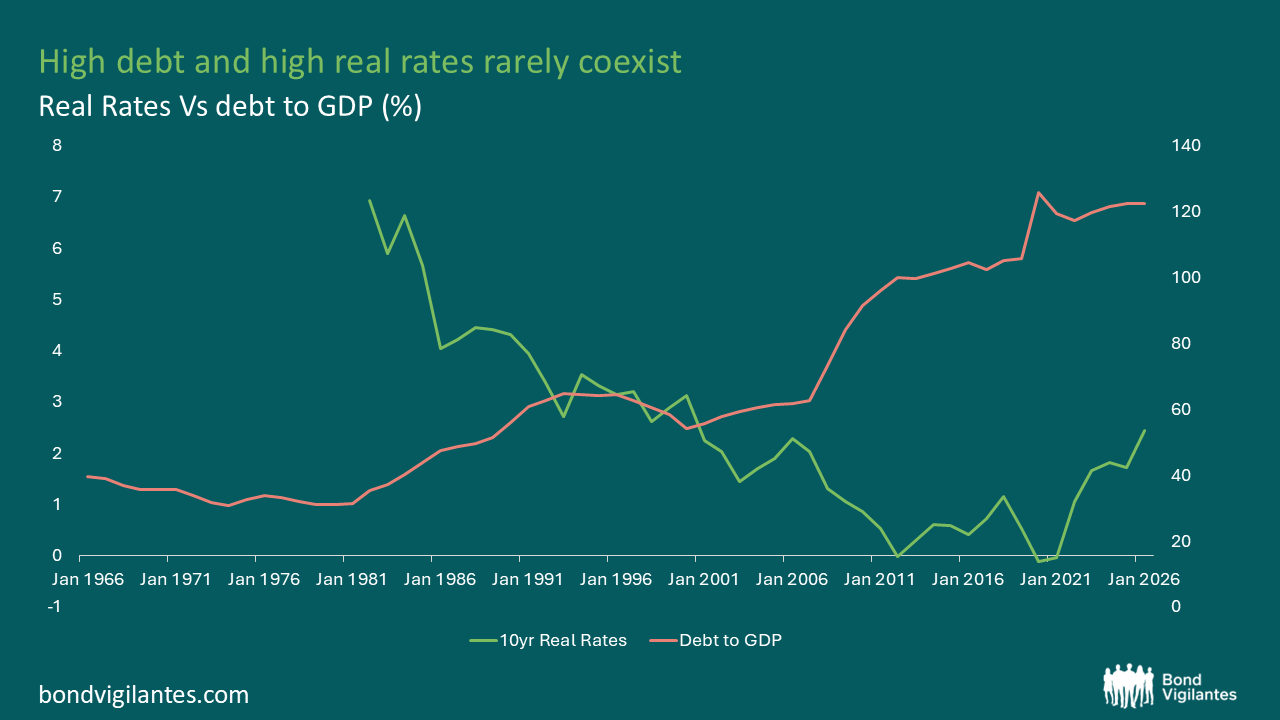
Over the last fifty years, debt-to-GDP has risen relentlessly while real interest rates have generally moved in the opposite direction. That relationship is unlikely to be accidental. Highly indebted governments and persistently high real interest rates have rarely coexisted for long.
The Arithmetic is uncomfortable
Governments have only a handful of ways to deal with rising debt burdens:
- Grow faster
- Raise taxes
- Cut spending
- Lower the real cost of borrowing
The first three options are becoming increasingly difficult. Ageing populations constrain growth. Tax burdens are already elevated across much of Europe. Spending restraint is politically unpopular almost everywhere.
That leaves a fourth option: ensuring borrowing costs remain below nominal economic growth for long enough that debt becomes manageable. This is financial repression.
Historically, this has often involved a combination of moderate inflation and interest rates that are held below where free markets might otherwise set them. The result is a gradual transfer of wealth from creditors to debtors as the real value of debt is eroded over time. Governments are the world’s largest debtors.
Can high real rates survive?
The post-pandemic period has delivered exactly the combination policymakers should fear: record debt levels alongside the highest real yields in more than a decade.
The consequence is visible in the first chart as interest expenses begin to consume a larger proportion of government revenues.
At some point, the question ceases to be whether high real rates are necessary to fight inflation.
Instead, it becomes whether governments can afford them.
The higher debt burdens rise, the greater the pressure to keep real borrowing costs contained.
The currency problem
Financial repression is not without challenges.
Any country attempting to suppress real rates on its own risks currency weakness, imported inflation and capital outflows. Markets have a habit of punishing the weakest link.
But today’s debt problem is not confined to a single country:
- The US is highly indebted
- The UK is highly indebted
- Much of Europe is highly indebted
- Japan is highly indebted
The incentives are remarkably similar across the developed world. Which raises an interesting possibility.
Rather than one country pursuing financial repression in isolation, the more likely outcome may be that everyone moves in the same direction at roughly the same time.
Not through formal coordination, but through shared necessity or some sort of calamity.
The great devaluation
If that happens, the adjustment mechanism changes.
Instead of one currency weakening dramatically against another, all currencies gradually lose purchasing power together. The devaluation does not occur in foreign exchange markets. It occurs relative to real assets.
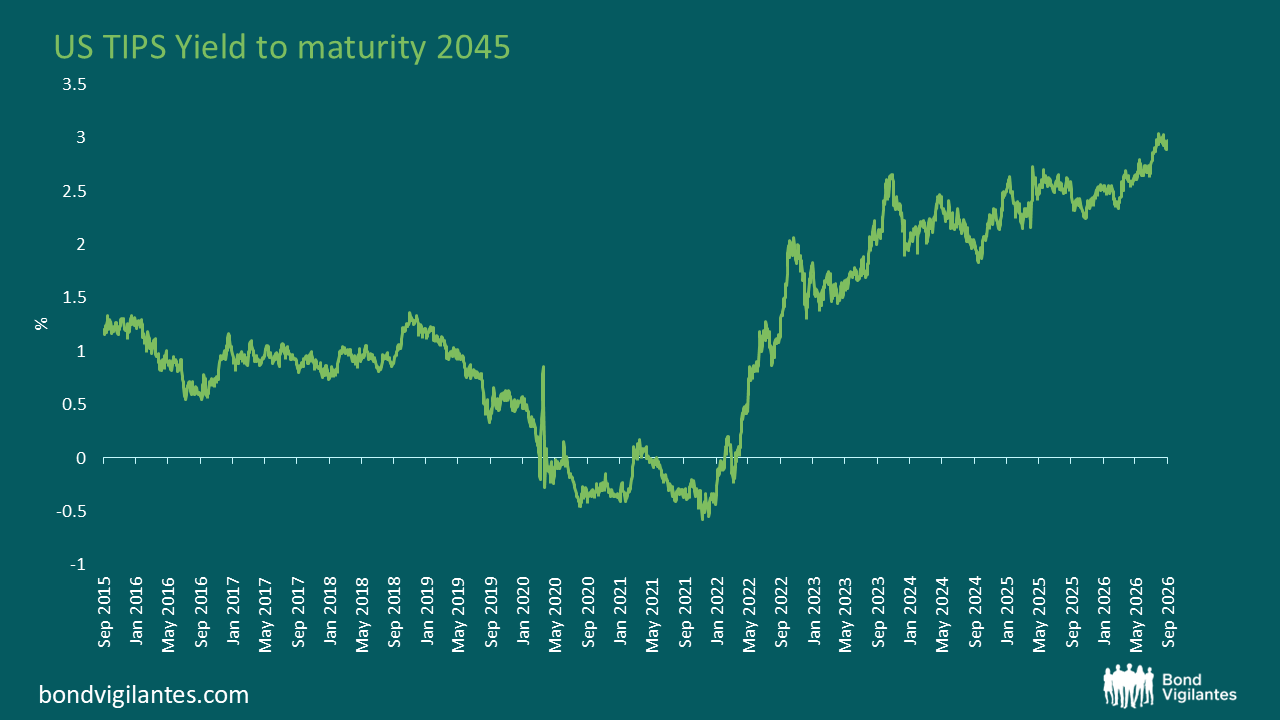
Gold, Commodities, Energy, Infrastructure are all moving higher yet Inflation-linked bonds are trading at the lows in price.
In that world, policymakers can tolerate a degree of inflation because no single currency is experiencing a disorderly collapse. Instead, the purchasing power of money slowly erodes across the developed world.
That may ultimately prove to be the most politically acceptable solution to excessive debt burdens.
The investment implications
Taken together, the two charts tell a coherent story.
The first chart explains why investors should care. Rising interest rates are beginning to consume an increasingly large share of government revenues. The second chart explains why policymakers should care. Debt-to-GDP ratios are now sitting at levels that were rarely seen during previous periods of elevated real interest rates.
Taken together, the charts pose an obvious question: can the developed world comfortably sustain today’s level of real interest rates with debt burdens exceeding 100% of GDP?
Perhaps it can. But if not, policymakers will eventually be forced to choose between fiscal austerity, higher taxation, or some form of financial repression that pushes real borrowing costs lower.
If governments are unwilling to pursue austerity and voters are unwilling to accept materially higher taxes, then financial repression increasingly looks less like a policy choice and more like a fiscal necessity.
For investors, that points towards assets that benefit from declining real yields and the erosion of fiat purchasing power.
Gold and Commodities have already moved meaningfully higher, yet TIPS are trading at the most attractive level in many years.
Source: Bloomberg
The big macro question we must ask ourselves is: ‘Are current interest rates sustainable given debt levels?’
The value of investments will fluctuate, which will cause prices to fall as well as rise and you may not get back the original amount you invested. Past performance is not a guide to future performance.