






What the Past Gets Wrong About the Future


Paramount Skydance’s (PSKY) recent $110 billion acquisition of Warner Bros. Discovery (WBD) was one of the largest corporate takeovers in history. Despite the deep equity pockets acquiring parties, it required a massive $52 billion in new debt financing across investment-grade bonds, high-yield bonds and leveraged loans, making it one of the largest debt financings in history. For high-yield investors, we estimate that the $12.4 billion of new bonds, combined with the existing bonds, will represent somewhere between 1.3% and 2.0%+ of the ICE BofA High Yield Global and US Indices respectively, making it difficult for index-aware managers to ignore, regardless of their reservations or enthusiasm for the combination.
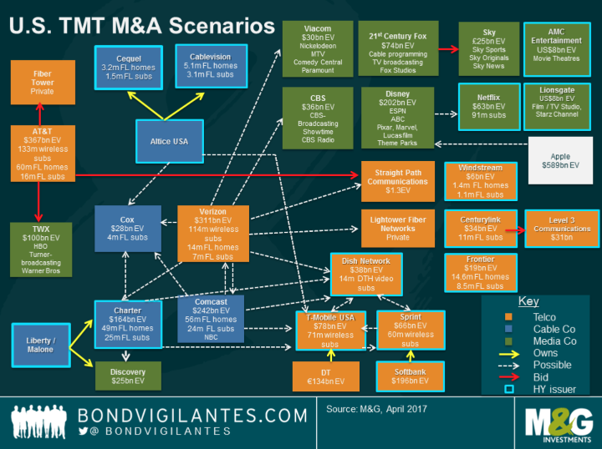
This got us thinking about not only the scale of the transaction, but about a blog Luke published nearly a decade ago and how dramatically US TMT has evolved since then.In 2017 when the blog was published, the US TMT sector was rife with merger and consolidation speculation as companies navigated a rapidly changing competitive environment and shifting consumer behaviour. US spreads had largely recovered from the Energy downturn and base rates remained low, encouraging acquisitions that were hopefully accretive and, no doubt, beneficial to lizard-faced management teams’ incentive plans as well.
Our analysts put together the chart below summarising many of the mergers, acquisitions and industry combinations being discussed across the sector. https://bondvigilantes.com/blog/2017/04/telecom-acquisition-spree-set-kick-off-u-s/
Source: Bloomberg H0EN, H0CV, data as at 12th October 2026. Spread = Gov OAS.
It wasn’t intended as a forecast, simply a snapshot of what investors, analysts and management teams were pontificating on, and of the animal spirits running through an industry where seemingly every scenario was being bandied about.
A number of the arrows eventually came to fruition. AT&T acquired Time Warner. Disney bought most of Fox’s entertainment assets. CenturyLink acquired Level 3 and T-Mobile eventually merged with Sprint. What stands out today, though, is not the transactions themselves, but how few ‘experts’ anticipated where many of these companies would ultimately end up. There’s probably an Oracle pun in there somewhere, but let’s carry on.
Netflix, Apple and Amazon are the most obvious examples. Few would have speculated that Netflix, which appeared on our chart with what now seems like a quaint $63 billion enterprise value (EV), would become one of the dominant businesses in global media. Apple was there too, viewed as a potential consolidator with the financial firepower to move into media, perhaps even for Disney. Amazon didn’t appear at all, but the once ‘humble’ online bookseller clearly had greater ambitions. All three have since spent billions on original content, even winning Oscars and Emmys along the way (not that anyone cares anymore). They have also acquired rights to established fan franchises and are increasingly competing for sports broadcast/streaming rights across the globe. And let’s not forget Amazon’s cloud computing and AI ambitions, but that’s another blog.
Then there were the incumbent TMT players. Technology changed consumer behaviour in ways that were not fully appreciated at the time, leaving some previously dependable businesses looking like the proverbial, if slightly overused phrase, “melting ice cubes”. Add some aggressive behaviour towards bondholders from a handful of billionaire owners, and the story became even more interesting or distressing, depending on your point of view.
John Malone’s Liberty Media 2017 purchase of Formula One, of all things, may have been a precursor of other unanticipated twists the sector would encounter. From Larry Elison’s Oracle effectively backstopping PSKY’s takeover of WBD to SoftBank shifting from selling Sprint to making enormous bets on AI, and even Elon Musk entering the fray with Starlink acquiring spectrum from satellite TV provider DISH.
But, let’s start with Time Warner. It appeared on our chart as a takeover target and, after a myriad of twists and turns, eventually became Warner Bros. Discovery ). In relatively short order WBD descended into high yield due to elevated leverage, continued declines in linear-TV that streaming/studio growth failed to offset. By then, any capable analyst would have seen the downgrade coming, although few would have anticipated that Paramount would have to outbid former DVD home delivery antagonist Netflix.
Then there’s the Altice USA saga. Altice USA was once viewed as an active consolidator, combining Cablevision and Suddenlink to capture synergies and market share. Ultimately, however, competition, subscriber losses and eye-watering leverage turned it into something of a basket case. The relationship with creditors descended into litigation over liability management and alleged asset transfers, claims the company disputes. Even the Altice USA name has gone, replaced by Optimum, continuing the time-honoured corporate tradition of changing names when things get difficult.
Charter went from a dependable, stable credit to one many market participants now wring their hands over, as cable’s secular challenges have intensified. Its $34 billion acquisition of Cox Communications is positively regarded as a consolidation story. But with pro-forma leverage in the low 4x range, that’s close to where the market has re-priced the EV multiples of cable companies. Compare that vs the 10x EV that Charter traded at as recently as 2021 and things look a bit dicey now. Plus, Charter is a significant index constituent, meaning market participants need to tread carefully.
DISH, arguably more of a melting ice cube than cable company, spent billions accumulating spectrum to reinvent itself as a wireless competitor while its core satellite TV business declined and debt piled up. Some suggested that DISH’s, erm, colourful owner Charlie Ergen was accumulating valuable spectrum less to build a viable wireless competitor than to monetise those assets later at a premium…hmm. Perhaps they were right, as DISH has since sold billions of spectrum to the likes of AT&T and Starlink. In the interim, however, bondholders endured asset-transfer disputes, distressed exchanges, prepackaged bankruptcies and plenty of litigation and lawyers’ fees. Again, probably a blog on its own.Just over a decade ago, US Energy was high yield’s problem child, littered with restructurings and bankruptcies, while TMT was seen as safe and dependable, supported by recurring revenues and predictable consumer behaviour. Meanwhile, technological advances lowered production costs and years of balance-sheet discipline, arguably imposed by a market that refused to fund leveraged growth, left most energy companies with stronger balance sheets and less sensitivity to commodity prices. Today, however, per the reasons detailed above, TMT investors face many of the challenges once reserved for energy. Quite a reversal of fortunes.
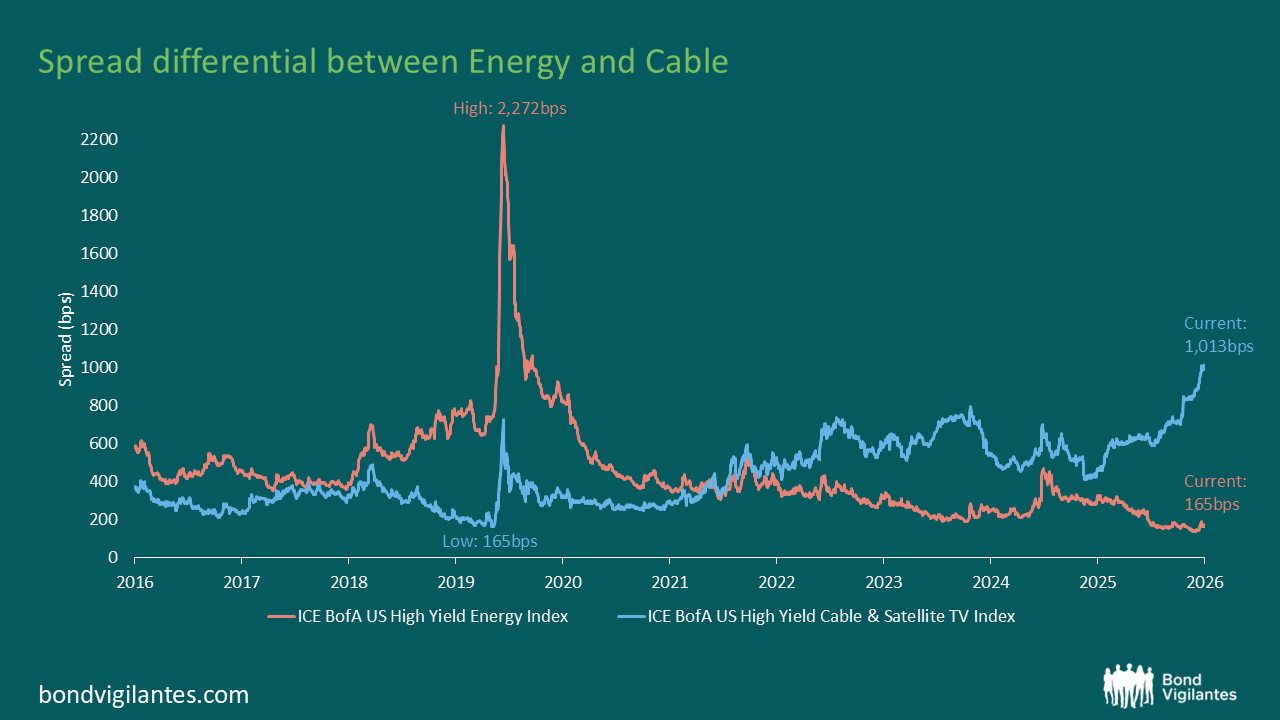
When it comes to the fates of TMT and Energy, I think it’s fair to ask if hubris played a role with regard to management teams believing they were invincible and to ask if complacency set-in among investors writ large, happy to enjoy the ride without questioning (or perhaps denying) warning signs. Leaving aside individual company circumstances, the behaviour of the two sectors provides valuable lessons when it comes to broader market evolutions and how to avoid or exploit such changing tides. It reminds me of the last line in F. Scott Fitzgerald’s The Great Gatsby: “So we beat on, boats against the current, borne back ceaselessly into the past….”
The value of investments will fluctuate, which will cause prices to fall as well as rise and you may not get back the original amount you invested. Past performance is not a guide to future performance.