






The Fire Horse at Mid-Year: When Capital Flows Outrun Fundamentals

At the start of the Year of the Fire Horse, we argued that Asian currencies were approaching a potentially important turning point. Stronger trade balances and evolving capital-allocation patterns had the potential to challenge several years of US dollar dominance. We also highlighted that, in a year characterised by the “Double Fire” element, any ascent was likely to be accompanied by heightened volatility and significant market swings.
Six months on, a clear and sustained appreciation trend in Asian currencies has yet to emerge. What has been more evident, however, is the volatility. Following a relatively constructive start to the year, the outbreak of conflict between the United States and Iran at the end of February introduced a very different market backdrop.
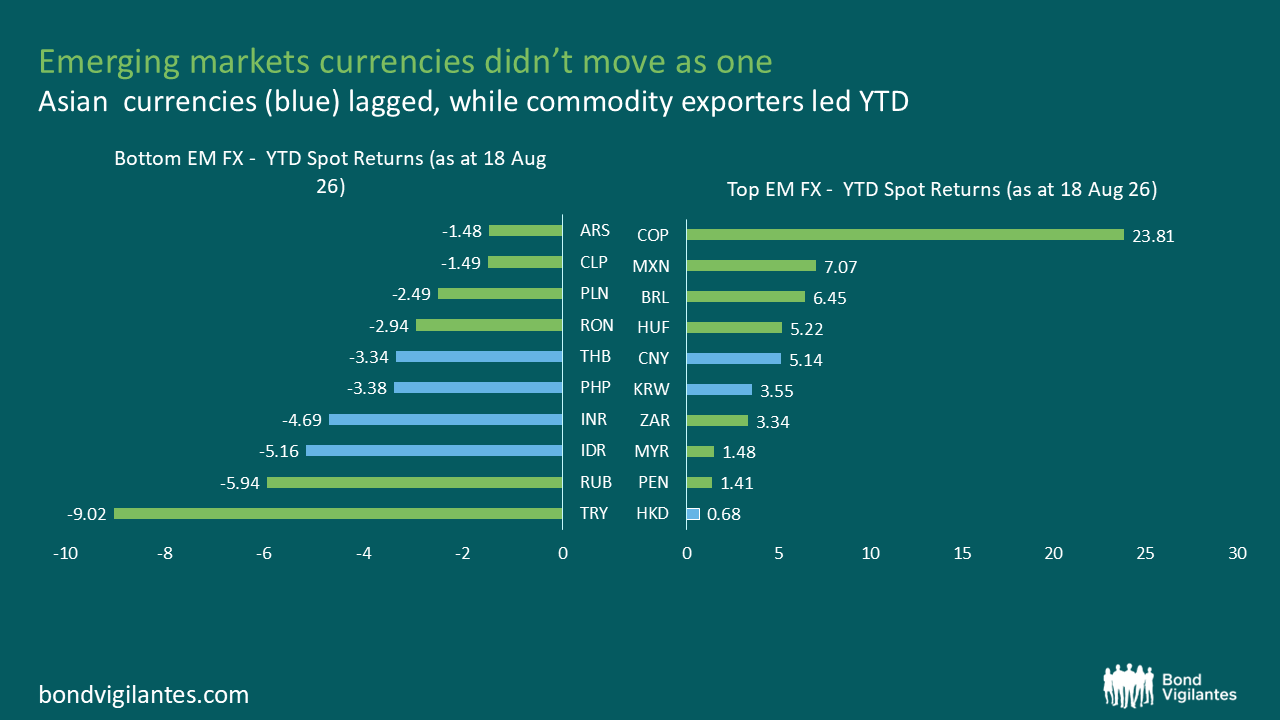
The resulting surge in oil prices, and its implications for Asia’s inflation outlook and external balances, complicated the outlook for local currency bonds and dampened investor sentiment toward regional assets. These concerns weighed particularly heavily on Asian currencies, given the region’s dependence on imported energy. As a result, Asian currencies broadly underperformed their emerging market peers, particularly those in Latin America, where many economies benefited from their status as commodity exporters.
Source: Bloomberg, as at 18 August 2026, based on spot returns against the US dollar
Each horse is still running its own race
The geopolitical shock amplified existing market divergences and heightened the sensitivity of capital flows to shifts in risk sentiment. While we anticipated greater differentiation across Asian currencies this year, the outcome has been more negative than expected.
Currencies such as the Philippine peso (PHP), Thai baht (THB) and Indian rupee (INR) came under pressure as investors focused on their exposure to higher oil import costs and, in some cases, more limited fiscal flexibility to absorb rising energy prices.
Market stress has also magnified country-specific considerations. In Indonesia, foreign outflows intensified weakness in the rupiah (IDR) amid concerns over fiscal policy and the broader policy direction of President Prabowo’s administration. Uncertainty around commodity export measures added to investor concerns.
The Korean won (KRW), by contrast, experienced pronounced swings over the past six months. Despite strong external fundamentals, including AI-driven export growth and a healthy current account position, the currency remained under pressure for much of the period as equity-market outflows and persistent outbound investment by domestic investors outweighed trade-related support. Since July, however, the KRW has staged a sharp recovery, supported in part by higher conversion of exporters’ foreign-currency earnings into won following policy encouragement from authorities.
China offers another example of that differentiation, with the renminbi (CNY) appreciating steadily over the period amid a clear preference among policymakers for a stronger currency.
When capital flows outrun fundamentals
The first half of the year has provided an important reminder that healthy macroeconomic fundamentals alone are not always sufficient to drive currency performance. Capital flows, shaped by global macroeconomic developments and shifts in investor asset allocation, can exert a powerful influence over exchange rates, particularly during periods of heightened uncertainty.
Nonetheless, we continue to believe that fundamentals matter over the longer term. They have helped cushion Asian currencies to varying degrees through the recent volatility, contributing to the significant divergence in performance across the region.
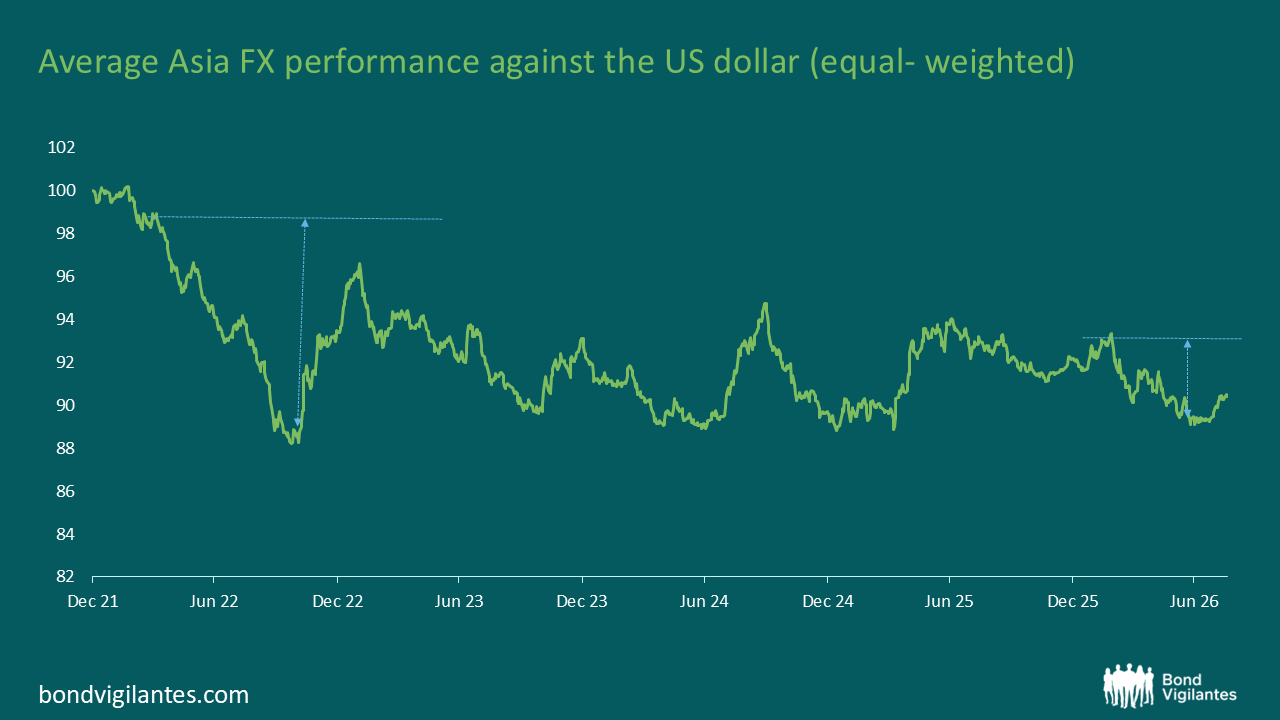
More broadly, the decline in Asian currencies has been relatively orderly compared with previous episodes of energy-price shocks. This suggests markets have repriced risk rather than moved into the kind of broad-based stress seen in earlier episodes. Asian currencies on average declined by 12% from peak to trough during the 2022 energy shock. By comparison, this year’s decline has been considerably more modest, at 4.5%.
Source: M&G, Bloomberg, as at 18 August 2026; Calculated using average daily spot returns of CNY, INR, IDR, KRW, MYR, PHP, SGD, TWD and THB against the USD.
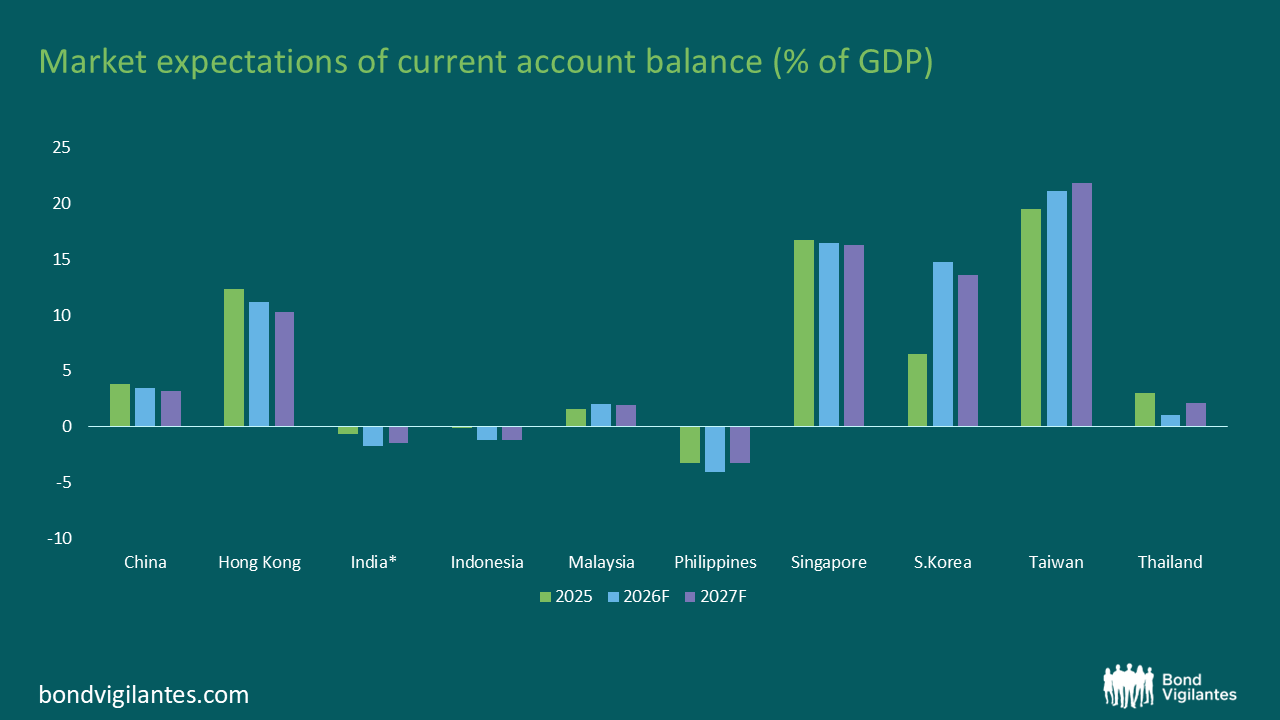
Importantly, Asia’s fundamental buffers remain largely intact. Despite higher energy costs, current account positions are not expected to deteriorate materially. Supported by continued strength in technology and AI-related exports, Malaysia, South Korea and Taiwan are projected to record larger current account surpluses this year than last.
Source: Bloomberg, 2026F and 2027F based on available median forecasts from Bloomberg contributors, extracted in August 2026. *India is based on financial-year data from CEIC and HSBC, June 2026.
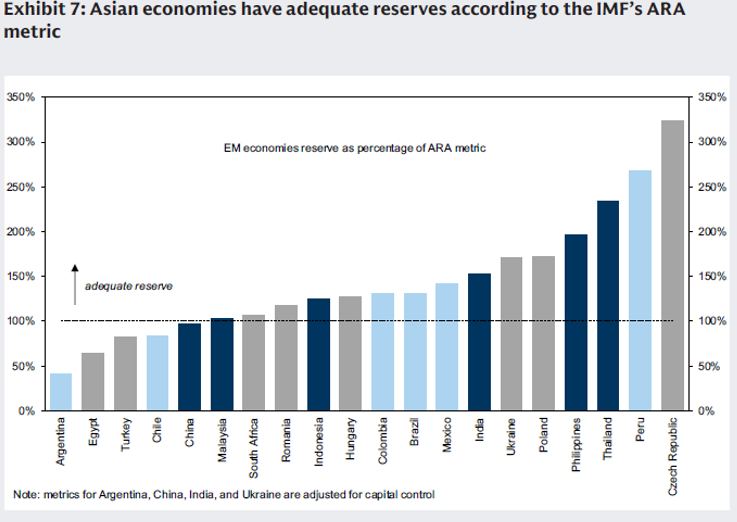
Foreign-exchange reserve positions also remain robust across the region, despite selective intervention by some central banks. While there is no universally accepted measure of reserve adequacy, the majority of Asian economies remain comfortably above levels suggested by the IMF’s reserve adequacy framework. The Philippines and India rank among the strongest in Asia on reserve-adequacy metrics, while India and South Korea continue to maintain sizeable reserve stockpiles of approximately $700 billion and $400 billion respectively.
Source: IMF, Goldman Sachs Global Investment Research
(based on report published in June 2026)
The importance of policy response
Significant uncertainty nevertheless remains around the global macroeconomic environment and evolving asset-allocation trends, both of which could continue to drive volatility in capital flows.
Asian policymakers are acutely aware of these risks and recognise that foreign-exchange intervention and policy rate adjustments alone may not be sufficient to address persistent currency weakness. As a result, we expect central banks and governments across the region to continue broadening the sources of foreign-currency inflows.
Measures aimed at encouraging exporters and domestic investors to increase currency conversion and hedging activity, together with initiatives designed to improve foreign investor access to onshore markets, are likely to remain important components of the policy toolkit.
South Korea has already moved in this direction. Policymakers have expanded the National Pension Service’s foreign-exchange hedging flexibility, encouraged exporters to accelerate the conversion of export proceeds into won, and stepped up monitoring of foreign-exchange market activity. Early indications suggest these measures have contributed to a rise in exporter US dollar conversions.
In India, policymakers have adopted a more direct approach to attracting foreign capital. Reforms including the removal of withholding and capital gains taxes, expansion of the Fully Accessible Route and the removal of investment caps have enhanced the attractiveness of Indian government securities. The Reserve Bank of India also introduced a concessional swap facility that enabled banks to hedge eligible three- to five-year FCNR(B) deposits at a significantly lower cost than prevailing market rates. A similar concessional swap facility was also introduced for public sector undertakings (PSUs) raising funds through External Commercial Borrowings (ECBs).
The FCNR(B) programme attracted $52.3 billion in inflows as at 13 August, exceeding the amount raised under a similar scheme introduced in 2013. The strong response prompted the RBI to announce the closure of the concessional swap window one month ahead of schedule. The response highlights policymakers’ willingness to deploy targeted measures to bolster external financing conditions and mitigate capital-flow volatility against a backdrop of India’s generally resilient macroeconomic fundamentals.
Looking ahead
Barring a renewed escalation in US-Iran tensions, we expect some of the macroeconomic headwinds that dominated the first half of the year to gradually ease. This should create a more supportive environment for underlying fundamentals to reassert themselves, particularly in markets where the policy response has been credible and proactive in addressing investor concerns, such as South Korea and India.
Following a prolonged period of weakness, valuations across parts of Asian FX have become increasingly attractive, even as inflation remains broadly contained. Moreover, policymakers across the region have become increasingly attentive to persistent currency weakness, recognising that it can exacerbate inflationary pressures and undermine efforts to attract more diversified and stable capital flows.
Combined with the repricing that has taken place across Asian local currency bond markets and continued strength in technology and electronics exports, we believe conditions are emerging for selected Asian currencies to recover part of their recent underperformance.
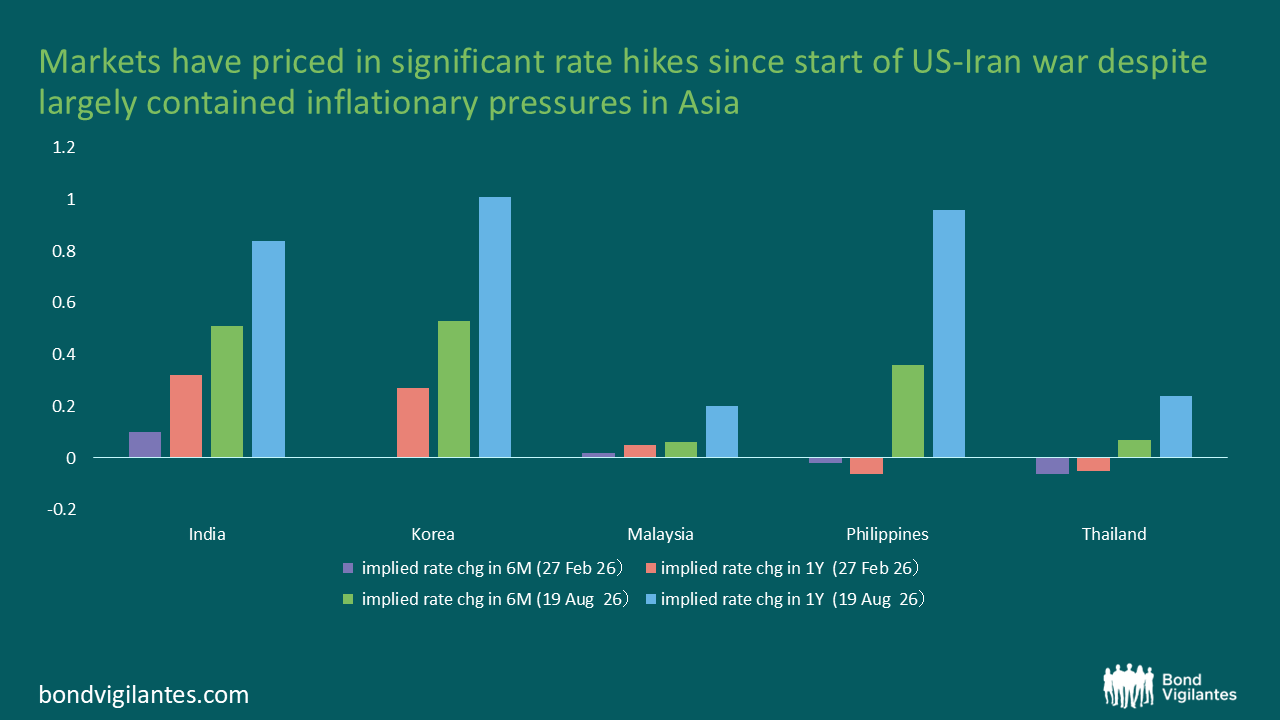
Source: M&G, Bloomberg, 18 August 2026
Dispersion remains the opportunity
At the beginning of the year, our argument was never that Asian currencies would move in lockstep. Rather, we expected the drivers of currency performance to evolve, making divergence within the region increasingly important. The first half of the Year of the Fire Horse has reinforced that view.
Many Asian economies continue to have meaningful external buffers. The technology and electronics cycle remains supportive for parts of the region, while recent market repricing has created opportunities across local currency bond markets.
Yet these advantages will not translate into identical outcomes. Capital flows, domestic policy choices and investor confidence will determine which currencies are able to translate strong economic fundamentals into stronger market performance.
For active fixed income investors, such dispersion is not merely a source of volatility. It is where some of the most compelling opportunities are likely to emerge.
The views expressed in this document should not be taken as a recommendation, advice or forecast. Please note, this article was first published in The Edge in Singapore and a translated version in the Hong Kong Economic Journal.
The value of investments will fluctuate, which will cause prices to fall as well as rise and you may not get back the original amount you invested. Past performance is not a guide to future performance.