


Mind the gap: Is high yield paid for the jump?

Anyone who has travelled on the London Underground will be familiar with the refrain “Mind the gap.” Curved platforms and straight rolling stock create an obvious hazard. High yield investors increasingly have a few gaps of their own to worry about.
At the headline level, the high yield market has been remarkably well behaved in 2026, notwithstanding some pressure through October. Spreads remain relatively tight, yields are attractive and, at first glance, there is little to suggest anything particularly unusual is happening. Look beneath the surface, however, and the picture becomes much more interesting. The relationship between BBB and BB-rated credit remains relatively normal compared with the experience of the past five years. But as you move down the ratings spectrum, things start to look very different. The gap between BBs and Bs has widened, while the divergence between stronger high yield credits and the weakest parts of the market has become more pronounced still. Increasingly, when the market decides a credit has a problem, it isn’t repricing it by 50 or 100 basis points. Bonds can rapidly move from the 90s into the 70s, 60s or below. The gap between performing and stressed credit is becoming a chasm.
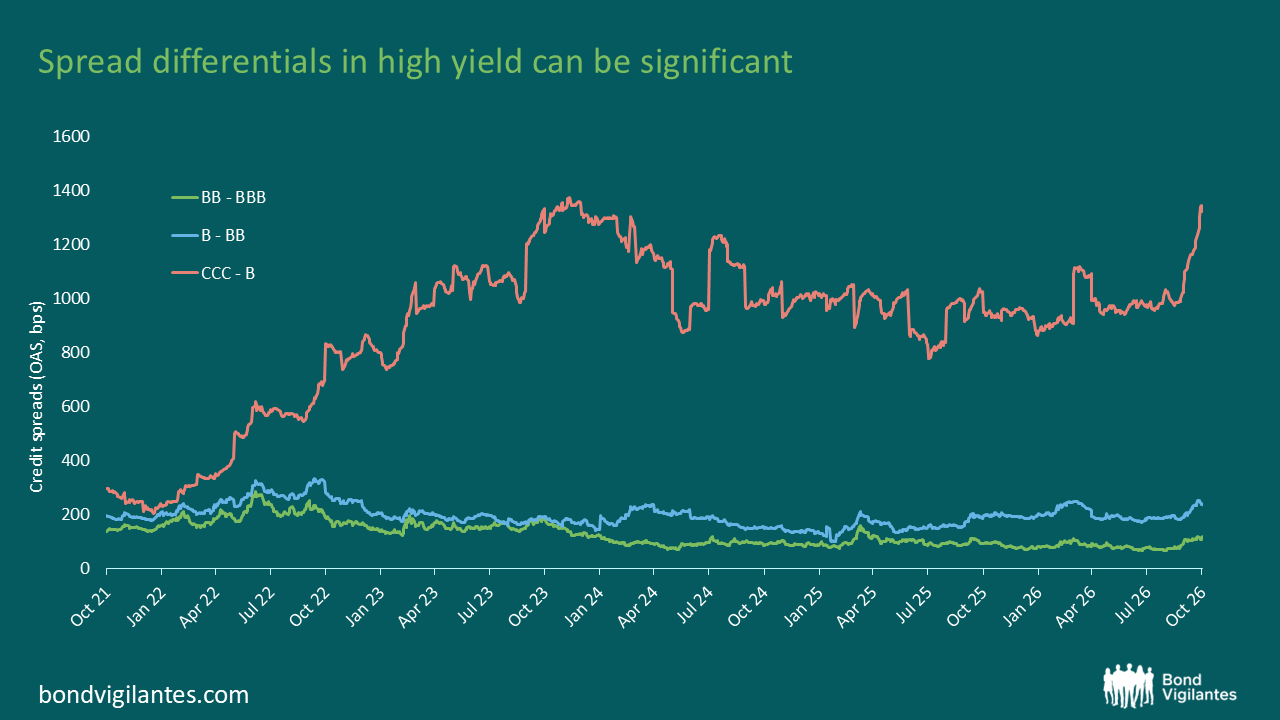
Source: Bloomberg Gov OAS, BBB (ER40), BB (HE10), B (HE20), CCC (HE30)
Part of the explanation is simply that investors are increasingly differentiating between those companies that can comfortably manage their debt loads and those where the equity cushion, refinancing prospects or underlying business model is being questioned. The end of an era of cheap money has significant consequences for the most levered of capital structures.
High yield markets have always been asymmetric. When a credit improves, bonds may grind gradually higher. When something goes wrong, they can fall very quickly. But there is an additional problem. There isn’t necessarily a smooth continuum of buyers between performing and distressed credit.
A traditional high yield investor might happily own a bond at 95. If the investment thesis deteriorates and that bond falls to 85, the instinct may be to sell rather than double down. Risk limits, fund flows, benchmark considerations and simple loss aversion can all reinforce that decision. Yet 85 may still look expensive to a distressed investor contemplating a potentially messy restructuring and demanding a much higher prospective return. At some point a bond stops being a cheap high yield bond and becomes an expensive distressed bond. Between the two there may be surprisingly few natural buyers. That creates a liquidity gap. When a bond crosses from performing into stressed territory, the marginal investor changes. Traditional high yield investors become sellers before distressed investors are willing to become buyers.
Finding that clearing level can require a dramatic adjustment in price. This also helps explain why apparently modest changes in fundamentals can sometimes produce enormous moves in individual bonds. The effect can become particularly pronounced towards year-end, when liquidity traditionally deteriorates and investors become increasingly reluctant to add new problem positions to their portfolios.
After a more challenging period for lower-quality credit, psychology matters too. Investors nursing losses elsewhere are rarely enthusiastic about catching another falling knife. The result can be a classic “sell first, ask questions later” market.
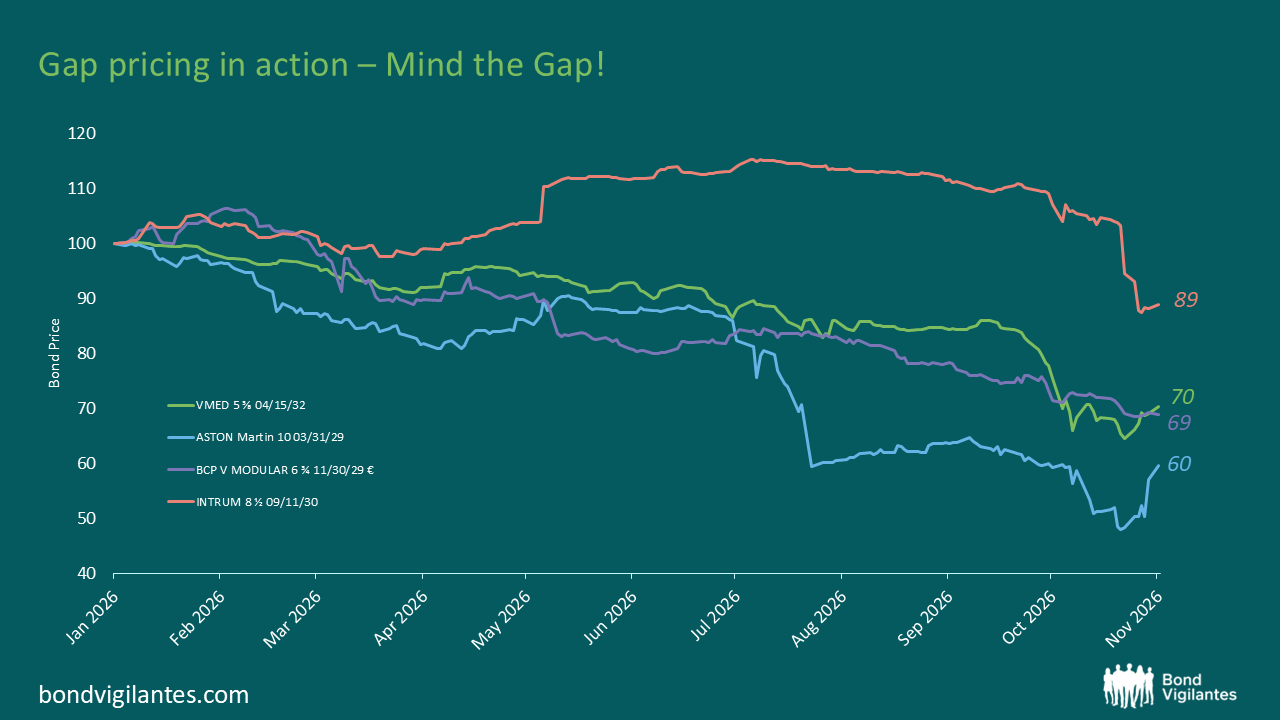
Source: Bloomberg last price, VMED 5 ⅝ 04/15/32, ASTON MARTIN CAPITAL HOL, BCP V MODULAR SERVICES, INTRUM 8 ½ 09/11/30 Corp
There is another reason investors are becoming more cautious about weaker credits. The recovery value they think they own may not be the recovery value they ultimately receive.
Years of borrower-friendly documentation have provided sponsors and companies with considerable flexibility. Depending on the documentation, companies may have scope to move assets, raise additional debt, provide collateral to new lenders or otherwise alter the priority of existing creditors.
These provisions don’t attract much attention while a business is performing. They matter enormously when it isn’t. This means that traditional recovery analysis based simply on enterprise value, leverage and the existing capital structure may provide a false sense of security. Investors increasingly need to consider not just what a company is worth, but what the capital structure might look like by the time the company actually restructures. The growth of US-style liability management exercises adds another dimension. Creditor-on-creditor violence may sound like something from a niche Netflix series, but it has become an important consideration for leveraged finance investors. Creditors that appear to own similar claims can potentially emerge with very different outcomes. Some may provide new money, participate in an exchange or receive enhanced collateral. Others may find themselves subordinated or simply left behind. The result is another gap: the gap between the recovery investors assume when they buy a bond and the recovery they may receive.
None of this necessarily means we are heading for a conventional default cycle. In fact, that is arguably the most interesting aspect of the current market. Investors can experience substantial credit losses without experiencing a surge in defaults.
A company doesn’t need to default for a bond bought at 98 to trade at 65. Deteriorating fundamentals, refinancing concerns, a poorly received acquisition, documentation risk or simply uncertainty around the future capital structure can be enough.
That creates an important distinction between default risk and gap risk. Traditional credit analysis often focuses heavily on probability of default and recovery in the event of default. Both remain important. But for a portfolio manager, the path between those two points matters enormously as well.
An investor may ultimately prove correct that a company avoids default, but that provides limited comfort if the bond falls 20 points along the way. And this is where today’s spread environment becomes particularly interesting. The additional carry available from moving from BBs into Bs and CCCs can look attractive. But a few hundred basis points of additional annual income provide surprisingly little protection against a 10, 15 or 20-point drawdown. It can take several years of incremental carry to compensate for a single credit falling through the gap.
Does that make us bearish on high yield? Not so fast. A market characterised by greater dispersion should ultimately create more opportunities for active investors.
When almost everything trades close to par and spreads move together, there is relatively little opportunity for fundamental credit analysis to differentiate between winners and losers. When individual companies begin to diverge, security selection becomes much more important.
The challenge is that the distribution of returns becomes less forgiving. The biggest risk to a high yield portfolio may not be a dramatic widening in the overall index. It may instead be a relatively small number of individual credits experiencing very large losses.
That places greater importance on diversification, risk control, understanding refinancing requirements, liquidity, capital structures and, increasingly, documentation.
There will undoubtedly be opportunities among bonds that have fallen sharply. Markets overshoot, liquidity-driven selling creates mispricings and not every company trading at distressed levels will ultimately restructure. But the price at which investors should be willing to provide that liquidity has changed.
In a market where headline spreads remain relatively tight but dispersion underneath the surface is increasing, reaching for the last turn of spread can be a dangerous strategy. Sometimes the most important question isn’t how much extra yield you are being paid.
It’s whether that yield adequately compensates you for the gap.
The value of investments will fluctuate, which will cause prices to fall as well as rise and you may not get back the original amount you invested. Past performance is not a guide to future performance.