






Bonds have their mojo back

The Oxford Dictionary definition of a bond (the finance version) is a document issued by a government, local authority, or company promising to repay borrowed money with interest over a long-term period. In a non-finance sense, a bond is a strong feeling of friendship, love, or shared ideas and experiences that unites people.
In recent history, most investors will agree that bonds haven’t delivered a very attractive level of interest. Incidentally, nor do I feel a particularly strong feeling of friendship or love for my recent fixed income investments – I, too, bought the infamous 2061 UK government bond.
However, given the recent sell-off in yields, especially that of the last month or so, have bonds finally got their mojo back?
The importance of yield
I almost feel a sense of discomfort writing something so elementary to a bond-savvy audience, but here goes: the starting yield on a bond largely dictates your future returns.
Now that’s out of the way, let’s put some numbers to it.
2022 was a difficult year for most bond investors, for reasons well documented. The start of the year was around the point that the sell-off in yields started to intensify, so we will start there.
The starting yield of the 10-year US Treasury was 1.51%. Fast forward to 30th September 2026, yields closed at 5.29%, for a total yield change of 3.78% over a 4 ¾ year period. If you held 10-year Treasuries over that period, you would have experienced a return of -13%, equivalent to -2.9% p.a. For completeness, all analysis assumes a constant 10-year maturity.
Now let’s consider if bond markets experienced a similar sell-off over the next 4 ¾ years. Starting at 5.29%, we follow the same path as the one recently trodden, taking us to a yield of 9.06% on 30th June 2031. Let’s put aside for one moment the absurdity of yields reaching those levels for the sake of this exercise. Holding 10-year Treasuries over that period would return you 9.3%, equivalent to 1.9% p.a.
The same sell-off in yields over the same period, but a 22.3% difference in returns. Simplistically, 22.3% divided by 4.75 years is a difference of 4.69% p.a. That is the 3.78% difference in starting yield, plus a bit of convexity to bridge the gap: at higher yields, a bond’s duration is lower, so the same rise in yields does less damage to the price.
Back to feeling a sense of discomfort, all of this is to say that: income carries a lot of weight.
Where might we go from here?
Separating the don’t knows from the do knows.
We don’t know if or when a resolution to geopolitical issues will ease supply-side inflation pressures, to what extent the large hyperscaler capex (and broader AI expansion) will impact the economy, or whether a larger degree of fiscal prudence will offer some respite for bond investors.
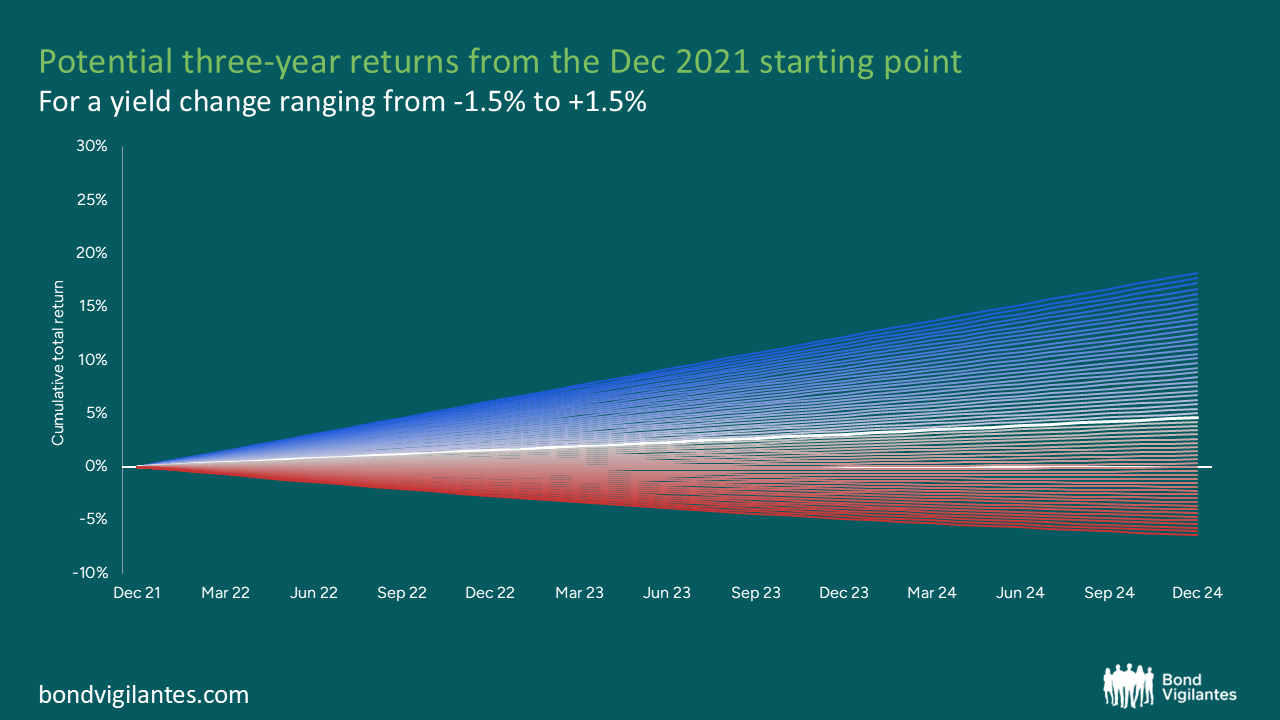
But, we do (now painfully) know that the range of potential returns over a three-year period on a 10-year government bond at a starting yield of 1.51% on 31st December 2021 left plenty of room for disappointment – and deliver it did: a three-year yield rise of 3.06% left investors with a return of -14.6% over the period. Looking at a narrower range of yield changes, the potential returns are shown below.
What we also do know is that the starting yield on bonds is at multi-decade highs.
And the last thing we do know is (apologies, for the final time…) that the starting yield on a bond largely dictates your future returns, and income carries a lot of weight. And that evidence is clear in the potential for attractive returns from this point onwards.
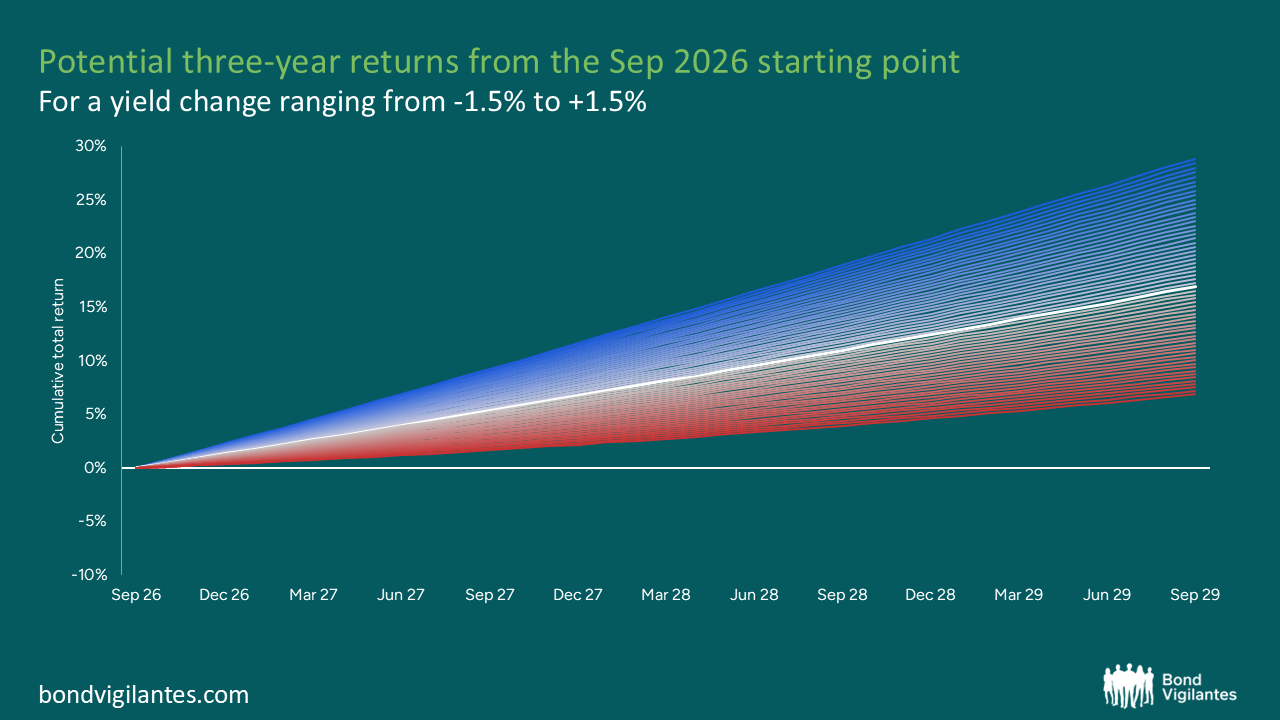
Putting aside one’s view on the world, I think we can all agree that at these levels, bonds have their mojo back.
The value of investments will fluctuate, which will cause prices to fall as well as rise and you may not get back the original amount you invested. Past performance is not a guide to future performance.