






Wigglesworth the Wait? A bond fund manager’s take on A Fabulous Debt.

Robin Wigglesworth, author of Trillions and editor of the Financial Times’ blog Alphaville, has come to market with a new book and I’ve been entrusted with reviewing it.Though an avid reader, I find book reviews surprisingly difficult. Give too little or too much away, there’s little reason for anyone to read it. But, in the interest of avoiding spoilers, I will say this: Think you know about bonds? Think again.
Bonds are now so firmly embedded in the financial landscape, that it is easy to forget they were once an innovation in their own right. For Wigglesworth, that provides the basis for A Fabulous Debt: an exploration of the bond market’s colourful past, centred around one burning question: “how did we get here?” The result? A Fabulous Debt is meticulously researched, genuinely fascinating and, perhaps most importantly for a book about bonds; extremely readable.
Some books teach you something entirely new, others remind you how much you have forgotten: A Fabulous Debt does both.
We tend to think about bonds through the language of modern markets: duration, spreads, ratings, curves, liquidity, supply, demand, default, risk, return etc. A Fabulous Debt steps back from all of that to remind us that these instruments, and the financial vernacular that surrounds them, didn’t simply spring into being. Instead, Wigglesworth takes centuries of complex economic and financial history and distils them into thoughtful, entertaining and digestible accounts, paving the path towards the financial world we recognise today.
For this particular Bond Vigilante, the book took me on a journey I never realised I was missing, answering questions I never knew I had. It’s actually mildly embarrassing to confess that despite spending nearly my entire adult life immersed in economics and bonds, I haven’t asked myself the most basic questions:
- Where was the first bond market?
- Who was the very first issuer of corporate bonds?
- When were bond ratings first used?
- When were the first bond funds launched?
- When was the first instance of QE? (Hint: it wasn’t this century!)
Thankfully, when casually quizzing my Bond Vigilante colleagues, many were also none the wiser. Cue Wigglesworth’s new read. A Fabulous Debt is a chronological, educational tale of the evolution of the bond market, without the bland execution that sentence (and my above questions) implies.
Indeed, it’s the structure and style which brings this particular read to life. Wigglesworth cleverly builds each chapter around a real-life protagonist, thereby using the titans who have shaped financial history to personify each period. He introduces the reader to these figures at pivotal moments in their careers, before stepping back to explore their backstory of personal circumstance, innovation and the contemporary events that ultimately led them to becoming so influential. It gives the book a strong narrative thread and turns what could easily become a dense history of financial markets into something much more engaging.
The reader starts off in 12th-century Europe with Doge Vitale II and his fleet of warships, before being swept through centuries of global financial history: watching Napoleon meet his match (spoiler: against the bond market!), riding the railway mania alongside Jay Cooke, and witnessing the rise of the first “bond king” through the Rothschild banking dynasty. From there, we’re kept moving right through to the big personalities of Michael Milken’s high-yield revolution and Lewis Ranieri’s MBS era, before eventually being deposited in the modern-day Fed alongside Jerome Powell, just as Covid-19 throws markets into turmoil. And those are only a handful of the characters and crises we encounter along the way.
As each chapter covers subject matter substantive enough to have inspired a whole book of its own, there is something rather impressive about getting what feels like nineteen books’ worth of information, condensed into one. Chapters on the innovative journey from corporate bonds to government bonds, emerging markets, yankee and eurobonds, FRNs, high yield, MBS, futures, swaps, repo, money market funds and QE – all are covered and that is no mean feat.
Where financial history can sometimes descend into a procession of dates, facts and figures, here it rarely does. Instead there are so many charming anecdotes sprinkled throughout; from the fascinating finding that the first bond was essentially an involuntary loan forced upon the wealthy, to the amusing story that some first-time wartime bond purchasers thought that they would have to make the interest payments, and bought the bonds anyway – patriotism at its finest!
But the book is much more than a collection of historical big players and amusing anecdotes, it’s an important body of work that explains the ancestry of the financial system we inhabit today. It provides fascinating insights into the financial ingenuity and economic power to-ing and fro-ing, across the Atlantic.
Like many I’m sure, prior to this read, my understanding of the US post-independence political period came somewhat from Lin-Manuel Miranda’s Hamilton and his musical depiction of the political horse-trading. Building on this, Wigglesworth transports the reader back to The Room Where it Happens, adding detailed insight and the geeky specifics of at least three bonds which came from it – it’s a shame Miranda didn’t choose to rap about those!
Another example where Wigglesworth adds discernible colour is to the freshly white-washed walls of Bretton Woods via John Maynard Keynes, for the most colourful description of the event/agreement I’ve read, turning what has previously been a rather dry read in an economics textbook into something populated by personalities, espionage, rivalries and competing national interests.
And the stories keep coming. I now know why the state capital of North Dakota is called Bismarck. I am kicking myself for missing the historical bond significance of Venice’s Rialto (especially given it was the destination of my very first business trip) and I chuckle at the unpalatable truth of how Luxembourg missed out on a €40 trillion industry to Brussels’ beer and mussels. I now also walk down London’s Change Alley with a renewed sense of historical awareness, understand how space-saving initiatives impacted futures trading forevermore and marvel at the fact that my daughter shares her birthday with the oldest still-active bond in the world (albeit 398 birth years apart) – this book is a veritable feast that is sure to improve your general knowledge and dinner-party tattle.
The long and short of it
As a journalist, Robin can obviously write, but the true accomplishment is that he’s produced something you’ll actually want to read.
It should be obvious by now that I would recommend A Fabulous Debt to anyone working in fixed income, if only for a deeper appreciation of just how many supposedly modern financial innovations have historical antecedents. But limiting its audience to bond-market people would rather miss the point. It’s just as interesting for someone coming at this cold, someone who watches governments announce ever-larger borrowing programmes and wonders who actually buys all their debt; someone who has heard references to QE or Bond Vigilantes (you need only make it as far as the intro to discover where our blog got its name) without ever quite understanding what it all means; or simply someone interested in how finance has shaped history. And if, like me, you have both friends and family who still do not really understand what you do every single working day, this may be the book for them. Halloween, perhaps to appreciate the terrifying ways in which bonds have occasionally shaken the world. Christmas, if you simply wish to gift them a better understanding of it.
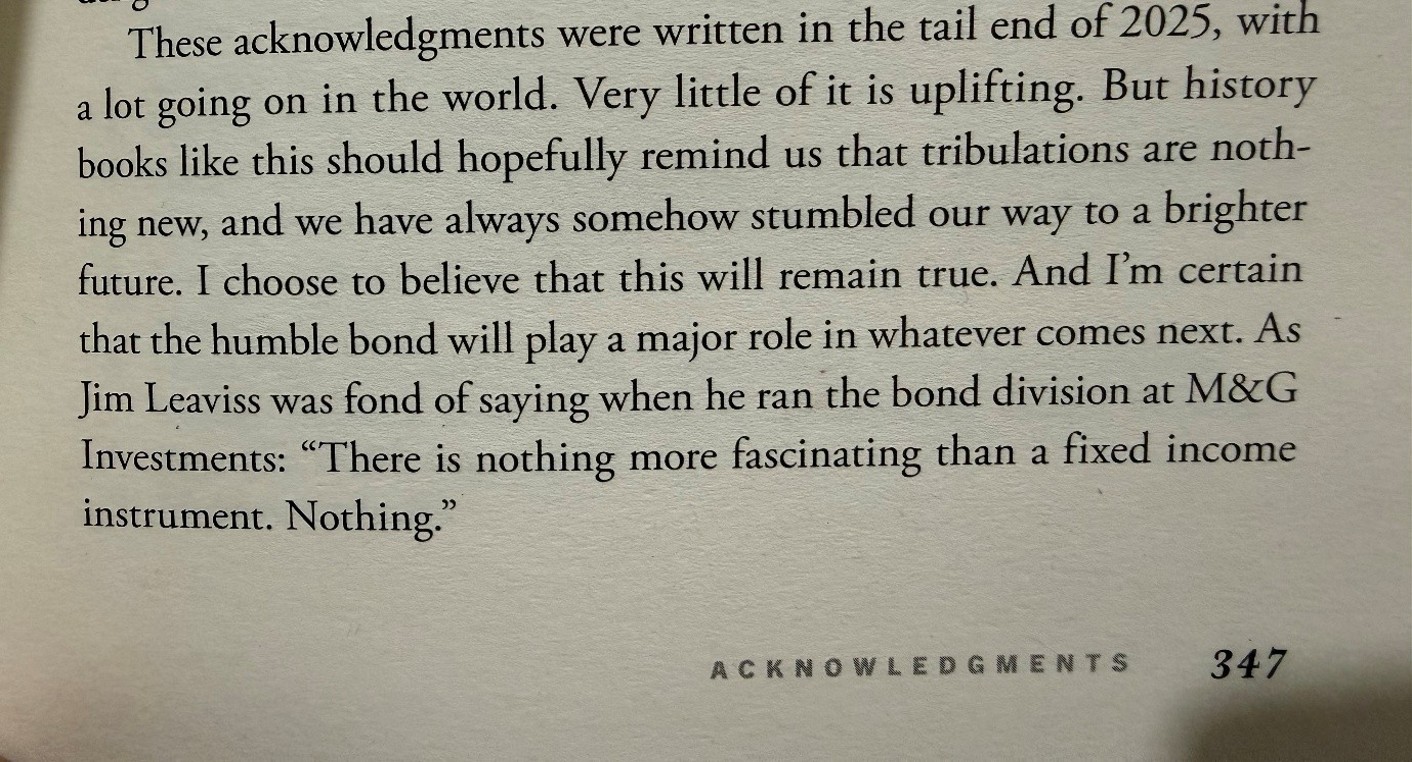
Ultimately, A Fabulous Debt is an elegant illustration of how the bond market has discovered, grown and innovated itself over several centuries and the key players that brought it all about. Who knew debt could be quite so entertaining? Well, our very own “founding father” of Bond Vigilantes, Jim Leaviss, who is not only mentioned in Wigglesworth’s acknowledgments, but touchingly quoted in the very last paragraph. So it feels very fitting to also bookend with Jim here, as Wigglesworth’s read very much proves his point.
The value of investments will fluctuate, which will cause prices to fall as well as rise and you may not get back the original amount you invested. Past performance is not a guide to future performance.