



Latam’s pivot to the “right” means the fiscal anchor is ‘muy fuerte’

When talking about the right or left in Latin America we need to make an important differentiation between what Latinos define as right or left versus Europeans. This is because, in Latam, the “right vs. left” debate is largely associated with the approach to governments’ fiscal stances, security, and corruption, and much less with immigration, sovereignty, and regional integration which are more common topics in the European discussion. With this in mind, we note that Latam’s recent pivot to the (Latam defined) “right” suggests a strong fiscal anchor ahead, which cements the positive momentum for bonds in the region.
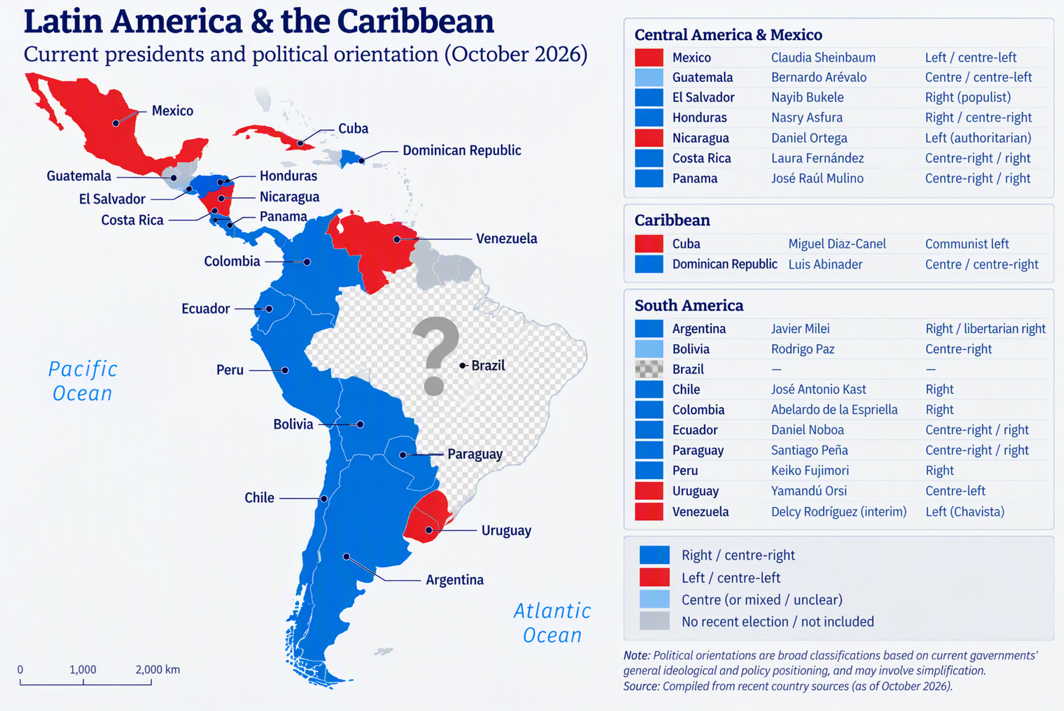
A very long list of Latam countries pivoting to fiscal consolidation: The pattern is quite striking. From 2022 to 2024 we had 9 elections in Latam and 6 of them were won by the right or center right. While this is already a large number, it gets way more noticeable over the last 2 years, as 100% of the elections held during the 2025 – 2026 period have so far been won by the right or center right. These results are shown in the table below where we plot results in blue (right/center right) and red (left/center-left). Brazil will hold its second round election on the 25th October. We don’t have a view on the outcome, but we note that the first round showed a greater than expected support for Flavio Bolsonaro, who has recently campaigned with a pair of scissors representing fiscal cuts (a catchy and similar marketing strategy to the one used by Milei in Argentina who campaigned with a chainsaw). Regardless of the outcome in Brazil, most of the region is now in the blue (see map below).

Source: Congressional Research Service (CRS), Reuters, Edelman
The “left-right” ping-pong is nothing new in Latam. The region is well known to have significant left/right swings which can also happen very fast (in some cases every 4-years). Most notable cases are for example: Colombia, which has gone Right (Duque), Left (Petro), Right (De la Espriella) in the last 3 elections, or Argentina which has flipped over the last 4 elections: Left (Cristina Kirchner), Right (Macri), Left (Fernandez), Right (Milei), and so on. Key topics such as security, and inequality (which remains large in the region) help explain why Latinos have a high tendency to vote for change, and social media has probably accelerated the swing speeds and the disliking against incumbents. In some countries like Uruguay, the left-right pivots hardly make any difference. This is because there is policy continuation regardless of the party in charge. My Uruguayan friends are not particularly happy when I simplify Uruguayan politics stating that “the left is the center, the right is the center, and the center is the center”. But in reality, their platforms differ in such a marginal way that it looks like all the same relative to its neighbors. Meanwhile, in other countries such as Argentina, Brazil, Ecuador, or Bolivia, these swings can cause significant market repricing, with bonds rallying on positive fiscal signals and selling off quite aggressively on prospects of fiscal deterioration. The clearest example of this dynamic can be seen in a note we published four years ago in October 2022. At that time, Charles de Quinsonas flagged how the region was pivoting to the left.
Regardless of the platform, it’s worth noting that fiscal consolidation has already shown improvement in recent years relative to the prior decade. Latin Americas’ debt to GDP (simple average excluding Venezuela) has been stable in recent years and is lower than the peak reached in COVID. The region’s debt-to-GDP is slightly above 60%, showing not only stability but also a significant improvement relative to the steady deterioration seen over the 2010 to 2020 decade. Going forward, if policymakers stick to their rhetoric of fiscal efforts, we would expect debt to GDP to trend lower from here. If history repeats itself we will have to re-assess another full swing right-left in the next presidential cycles, but until then, bonds are likely to be well anchored amid a wave of austerity efforts.
In addition to the fiscal anchor, recent political shifts bring some geopolitical benefits. Bilateral relationships with the current US administration remain on a solid footing across much of Latin America, and this helps to keep risks such as tariff disputes and other macroeconomic threats at relatively low levels, reducing bond market volatility to headline news. Another positive spillover is that corporate bonds in regulated sectors, including utilities, metals & mining and oil & gas, can benefit from these dynamics as well.
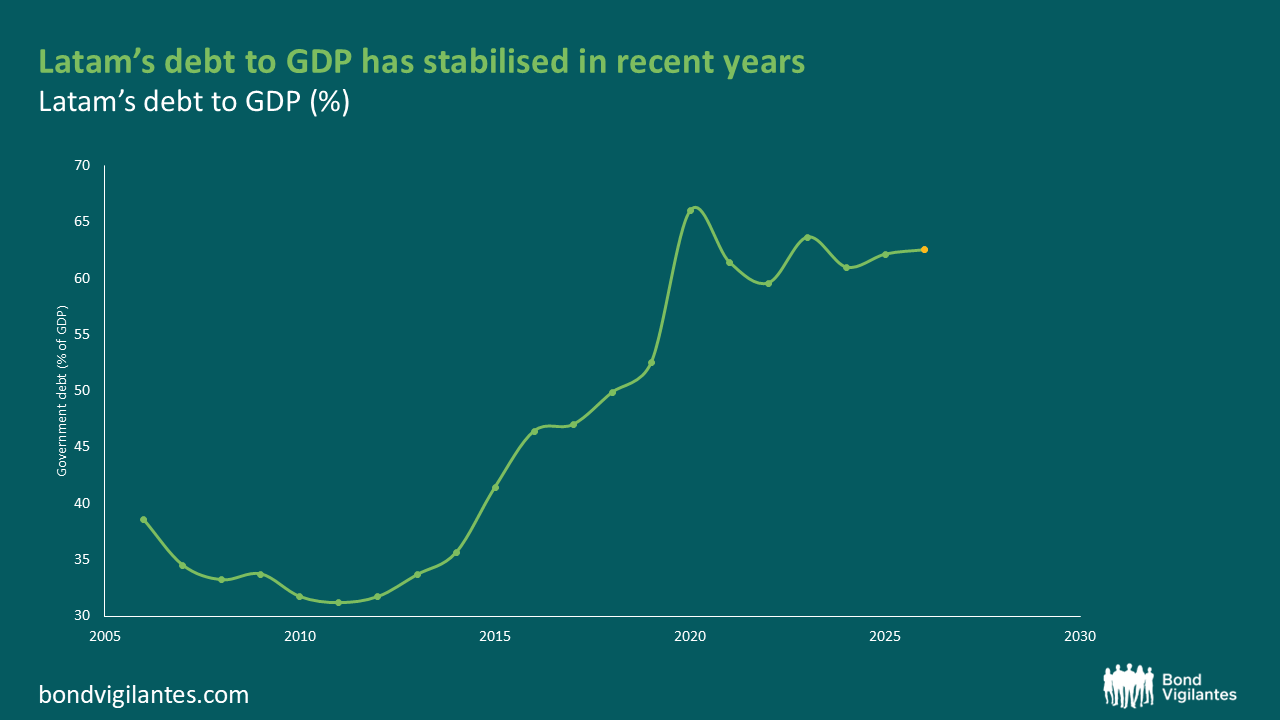
Source: Simple weighted IMF past data and forecasts.
The value of investments will fluctuate, which will cause prices to fall as well as rise and you may not get back the original amount you invested. Past performance is not a guide to future performance.