






Who backstops the backstop?

For most of the euro’s existence, investors have operated under an implicit assumption: Germany would always be there.
Germany was the creditor nation, the fiscal conservative, and the industrial powerhouse. When the next euro crisis inevitably arrived, Germany would ultimately provide the political and financial support required to hold the monetary union together. That assumption helped underpin confidence in everything from Italian government bonds to the common currency itself.
But what happens when the guarantor begins to weaken?
The question is no longer hypothetical.
The cracks in the foundation
For years, Germany’s economic model appeared almost unbeatable. It combined world-class engineering, a globally competitive manufacturing base, relatively cheap Russian energy, robust fiscal discipline and voracious demand from China for German machinery, automobiles and capital goods. Today, nearly every pillar of that model is under strain.
Energy costs have risen structurally since the loss of Russian gas. The population is ageing. Fiscal conservatism is becoming increasingly difficult to maintain in a world demanding greater defence spending and infrastructure investment. Most importantly, Germany is facing a competitor it never expected: a China that has evolved from customer to rival.
For decades, Germany’s manufacturers comforted themselves with the belief that China produced cheap goods while Germany produced sophisticated ones. That distinction is becoming increasingly obsolete.
China no longer competes primarily through low wages. It competes through scale, technology, engineering talent, vertically integrated supply chains and increasingly world-leading manufacturing capability. Electric vehicles are perhaps the clearest example.
For years, German automakers dominated premium engineering. Today, Chinese firms are often setting the pace in batteries, software integration and EV manufacturing efficiency. What was once Germany’s crown jewel is becoming one of its most vulnerable sectors. The poster child of the German automotive industry, Volkswagen, has announced another 50,000 jobs to be cut by 2030. This equates to a 15% reduction in its workforce. The challenge extends far beyond automobiles.
Industrial equipment, robotics, chemicals, renewable technology, advanced materials and manufacturing machinery are all industries where Chinese firms are moving aggressively up the value chain. Germany is increasingly finding itself squeezed between lower-cost competitors and technologically advancing Chinese champions.
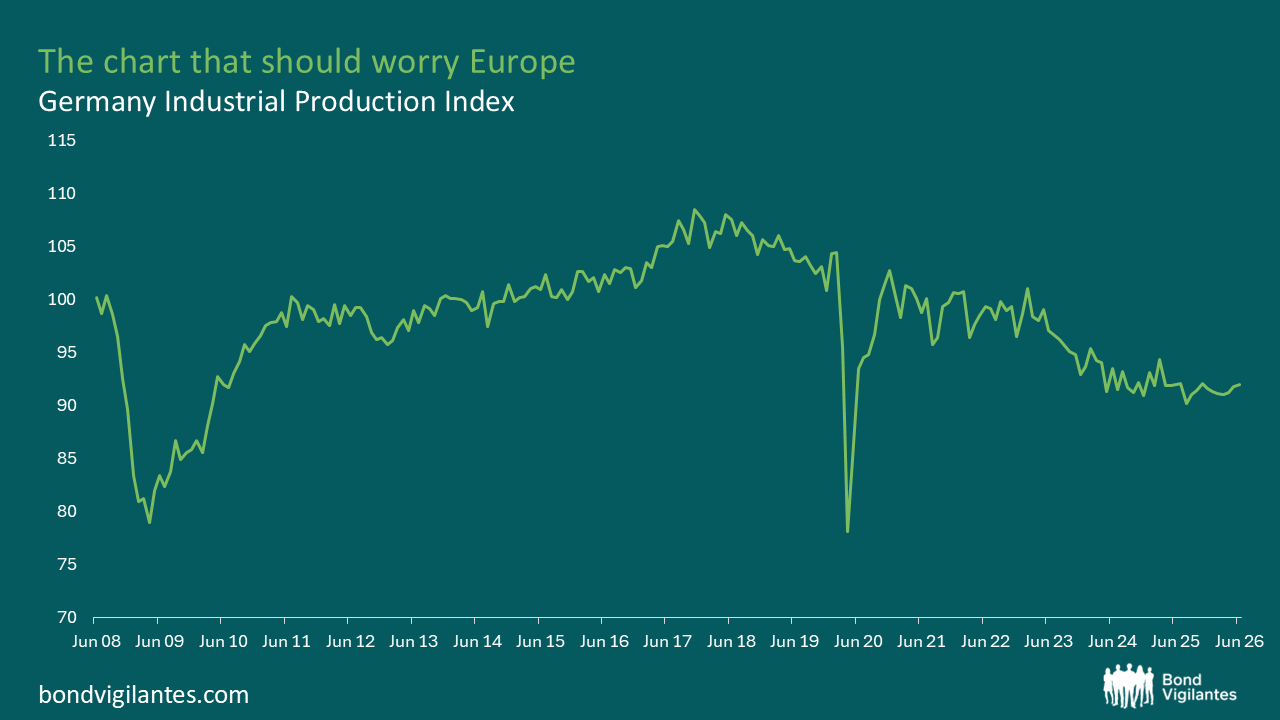
Source: Bloomberg, DEI200 Index
The decline in German industrial production tells a larger story. While recessions come and go, industrial production typically recovers over time. Germany’s has not.
The index peaked around 2017-18 and has spent much of the subsequent period in a persistent downtrend. By June 2026 it stood at just 92, levels previously associated with periods of acute economic stress. This is not merely a cyclical downturn. The troubling feature is that the deterioration has continued despite significant fiscal support, a post-Covid reopening, and repeated hopes that manufacturing activity would rebound.
If Germany’s industrial engine is merely experiencing a temporary slowdown, the chart should eventually recover. If instead the chart is capturing the gradual erosion of Germany’s competitive advantage, then the implications become far more significant.
From anchor to participant
Investors still tend to view Germany as the unquestioned anchor of the euro area. That assumption may deserve greater scrutiny.
One of the reasons markets have historically been comfortable owning Italian, Spanish or French debt is the belief that German balance sheet strength ultimately sits behind the architecture of the monetary union.
In effect, Germany has functioned as Europe’s implicit insurance policy. But insurance is only credible if the insurer remains financially stronger than the insured. Germany’s government debt remains lower than many of its peers, but the trajectory is changing. Defence spending is increasing. Infrastructure needs are growing. Political pressure for fiscal expansion is rising. None of this suggests an imminent fiscal crisis. The risk is more subtle.
Germany is gradually moving from being Europe’s unquestionably strong balance sheet to simply being another highly indebted developed economy facing slower growth and rising spending demands. The stronger Germany’s own fiscal requirements become, the less capacity it has to underwrite those of others.
The market has not fully priced the question
The market continues to price Germany as Europe’s risk-free asset. Bunds remain the benchmark. German finances remain the reference point against which the rest of the continent is judged.
Yet the industrial backdrop suggests investors may be looking in the rear-view mirror. Europe’s sovereign architecture was built around a Germany that generated persistent industrial surpluses, commanded technological leadership and consistently outperformed its neighbours.
The Germany of 2026 looks increasingly different. Its manufacturing base is shrinking, its competitive moat is narrowing, its fiscal commitments are growing, and its largest trading partner has transformed from a customer into a formidable rival. For years, Europe’s cohesion has relied upon an assumption that Germany’s strength was permanent. The industrial production chart suggests investors should at least begin asking whether that assumption still holds.
Because if the foundations supporting Europe’s anchor are weakening, the next euro-area stress episode may look very different from the last one. In a world of increasing rates and competition for capital, should we start to view Europe again as a convergence trade but from the other direction?
The value of investments will fluctuate, which will cause prices to fall as well as rise and you may not get back the original amount you invested. Past performance is not a guide to future performance.