






Europe’s new energy scare: Crisis or false alarm?

European natural gas prices are rising again, storage levels are lower than expected, and memories of the 2022 energy crisis remain fresh. But does this really constitute a new energy crisis for Europe, and more importantly for bond investors, does it change the ECB’s policy outlook?
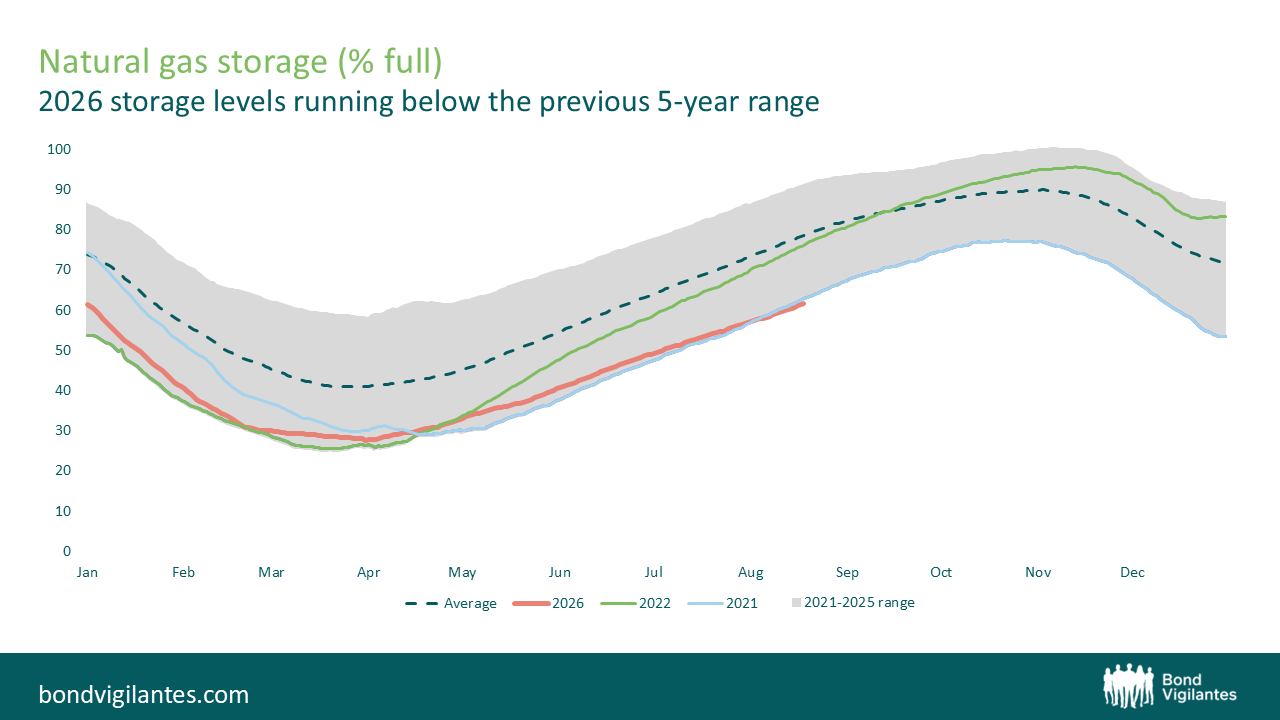
Source: Bloomberg, August 2026
A recent note from RBC European Macro Strategy argues that Europe may be transitioning from an oil shock to a natural gas shock, with potentially important implications for inflation and monetary policy. The note highlights European gas storage levels of roughly 60% compared with a historical August average closer to 75%, alongside weaker liquefied natural gas (LNG) imports and increased competition from Asia for marginal cargoes. Their conclusion is straightforward: natural gas matters more than oil for European inflation, and investors may be underestimating the risk that higher gas prices delay ECB easing. The argument deserves attention. But it also deserves scrutiny.
At first glance, the setup looks uncomfortable. European gas inventories are entering the winter refill season from a weaker starting point than has become customary since Russia’s invasion of Ukraine. Europe is also more dependent on global LNG markets than it was historically, exposing the region to supply disruptions and stronger competing demand from Asia. If inventories fail to rebuild and winter proves colder than expected, wholesale prices could rise rapidly.
The inflation transmission mechanism is well understood. Unlike oil, natural gas sits at the heart of Europe’s energy system. It influences electricity prices, industrial production costs and household utility bills. A sustained increase in gas prices therefore tends to have a broader impact on inflation than an equivalent move in crude oil. For ECB policymakers, that matters. The central bank has spent the past two years trying to ensure that the energy shock of 2022 does not become embedded in wages and inflation expectations. Any renewed rise in energy costs risks complicating that mission.
The problem with comparing today’s storage levels with those of previous years is that Europe’s gas demand has fundamentally changed. Before the energy crisis, the EU consumed roughly 400-420 billion cubic metres of natural gas annually. Today, consumption is closer to 320-340 billion cubic metres. Depending on the measure used, demand has fallen by approximately 15-20%. That is not a cyclical fluctuation but a structural adjustment. Industrial consumption has fallen sharply as energy-intensive sectors have closed capacity, relocated production or improved efficiency. Residential demand has declined following investment in insulation, heat pumps and conservation measures. Meanwhile, renewable generation has expanded significantly, reducing the amount of gas required to produce electricity.
One uncomfortable truth is that Europe’s resilience today partly reflects demand destruction. Some industrial activities simply no longer occur at the same scale. High energy prices have permanently altered parts of Europe’s industrial landscape. From a competitiveness perspective this is hardly positive and has seen the likes of Sir Jim Ratcliffe, founder of Ineos, accusing the EU of “industrial suicide.” From a gas security perspective, however, it has reduced vulnerability.
Europe has also become considerably better prepared operationally. Governments have accumulated experience managing energy shortages. Utilities have improved hedging programmes. Emergency planning frameworks are more robust. Renewable capacity has grown rapidly, while French nuclear output has largely recovered from the disruptions experienced in 2022 and 2023. Taken together, these changes mean Europe requires less gas to generate a given amount of economic activity than it did only a few years ago.
For bond investors, the key question is not whether gas storage is low. The key question is whether gas prices rise sufficiently to materially alter the inflation outlook and ultimately inflation expectations. The ECB’s focus today is increasingly on domestically generated inflation, wage growth and services prices. In theory, policymakers should be willing to look through external supply shocks, although the post-pandemic inflation cycle is still fresh in many minds. While a gas-driven inflation surprise cannot be dismissed, it may be more likely to delay future easing than to trigger an outright return to monetary tightening.
Investors should watch several indicators carefully over the coming months:
- Storage levels falling materially below current expectations.
- A significant acceleration in Asian LNG demand.
- Persistent disruption to global LNG supply chains.
- Winter weather forecasts turning sharply colder.
- TTF gas prices moving sustainably above €60-70/MWh.
- Evidence of substantial increases in household energy tariffs for 2027.
Absent these developments, talk of a “new energy crisis” may be premature.
The value of investments will fluctuate, which will cause prices to fall as well as rise and you may not get back the original amount you invested. Past performance is not a guide to future performance.