


Front-end relief, long-end grief

For bond investors, recessions once offered a reassuringly familiar script. Growth weakened, unemployment rose and inflation subsided. Central banks cut interest rates. Bond yields fell. Owning duration required patience, but rarely much imagination.
The next downturn, when it eventually arrives, may demand more of both.
Central banks will probably respond much as they always have, provided inflation allows. Governments will enter the slump with fewer advantages: heavy debts, persistent deficits and spending commitments that cannot easily be postponed. The same recession that persuades monetary policymakers to cut rates could persuade investors to demand more compensation for lending to the state.
The front end would respond to rising unemployment and rate cuts. Further out the curve, investors would have to contend with the fiscal cost of the downturn.
The postponed reckoning
It has been some time since investors experienced a conventional recession. In America, the last officially dated downturn ended in April 2020. Before that came the financial crisis, which ended in June 2009.
COVID-19 unquestionably caused a recession, but it is a poor guide to the next one. Its origins lay in a public health emergency, rather than the usual accumulation of economic imbalances, and the response was designed to preserve firms and employment through an externally imposed interruption. The usual sorting of viable businesses from unviable ones was deliberately suspended.
There were good reasons for doing so, yet repeated intervention carries consequences. Support can prevent a liquidity crisis from becoming an economic catastrophe, but it can also keep weak businesses alive, discourage the repricing of risk and transfer private liabilities to public balance sheets.
The danger is that investors have become accustomed to policymakers stepping in during periods of stress, without paying quite as much attention to the fiscal cost of doing so. Policymakers can soften a downturn, they cannot guarantee that doing so will remain cheap.
Recessions are expensive
A recession attacks the public finances from both directions. Falling employment reduces income-tax receipts, weaker profits depress corporation tax, and cautious consumers contribute less through spending taxes. Meanwhile, unemployment benefits rise and demands for discretionary support multiply.
The sums can be substantial: looking back at past recessions, the average deterioration in the budget deficit is around 4 percentage points, admittedly with a fair amount of variability around that.
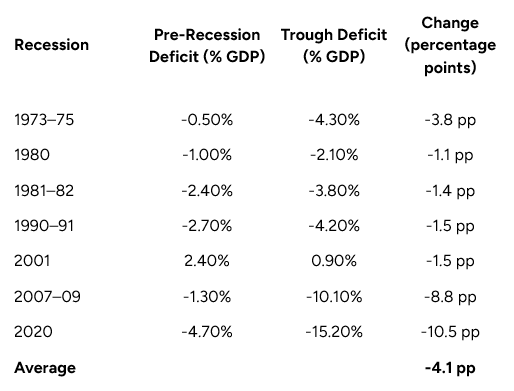
A government entering a downturn with a sizeable deficit can emerge with a borrowing requirement once reserved for emergencies. Take a moment to think about a budget deficit in the US of 10% of GDP.
Historically, falling interest rates provided some relief. Governments borrowed more, but often at lower yields. The next recession could test that convenient relationship.
Many countries already struggle to reconcile their promises with their revenues. Ageing populations, defence spending and the refinancing of cheap debt all compete for funds. A recession would arrive on top of these commitments. The problem is that relatively little fiscal repair took place while the economy was strong. The next recession therefore starts from a much less comfortable position.
A faster labour-market shock
Artificial intelligence could make the adjustment more abrupt. Businesses have spent years exploring how automation might reduce their staffing needs, but dismissing employees while profits rise attracts unwelcome attention. A downturn supplies a familiar explanation: restructuring.
AI may complement employees and raise productivity, and its effect on aggregate employment remains uncertain. But firms entering a recession with automation plans already prepared may be able to cut costs more quickly, potentially making the usual weakening of the labour market more abrupt than in previous cycles.
The fiscal consequences would follow quickly. Each lost job removes a taxpayer and may add a benefit claimant. Lower consumption weakens other businesses, inviting further retrenchment. An initially modest slowdown could produce an unexpectedly sharp deterioration in employment and in government accounts.
For the yield curve, that creates two simultaneous messages: cut interest rates sooner; issue more debt.
Two ends, two verdicts
Short-dated government bonds are closely tied to expectations for central bank policy. A sharp rise in unemployment, accompanied by easing inflation, should pull yields lower.
For thirty-year bonds, expectations for future short rates matter, but so does the premium investors demand for holding long-term debt. Greater uncertainty over inflation, fiscal policy and the supply of bonds could push that premium higher.
Long yields could therefore fall much less than short yields, and indeed they might barely move. In a more troubling outcome, they could rise while central banks were cutting.
Nor does the steepening argument require a sell-off in long bonds. A substantial rally at the front end, accompanied by a modest rally at the long end, would suffice. The recession trade could work through the difference between maturities rather than an outright bet on falling yields.
Looking back at the curve and where it is today, there appears to be considerably more room for it to steepen than to flatten.
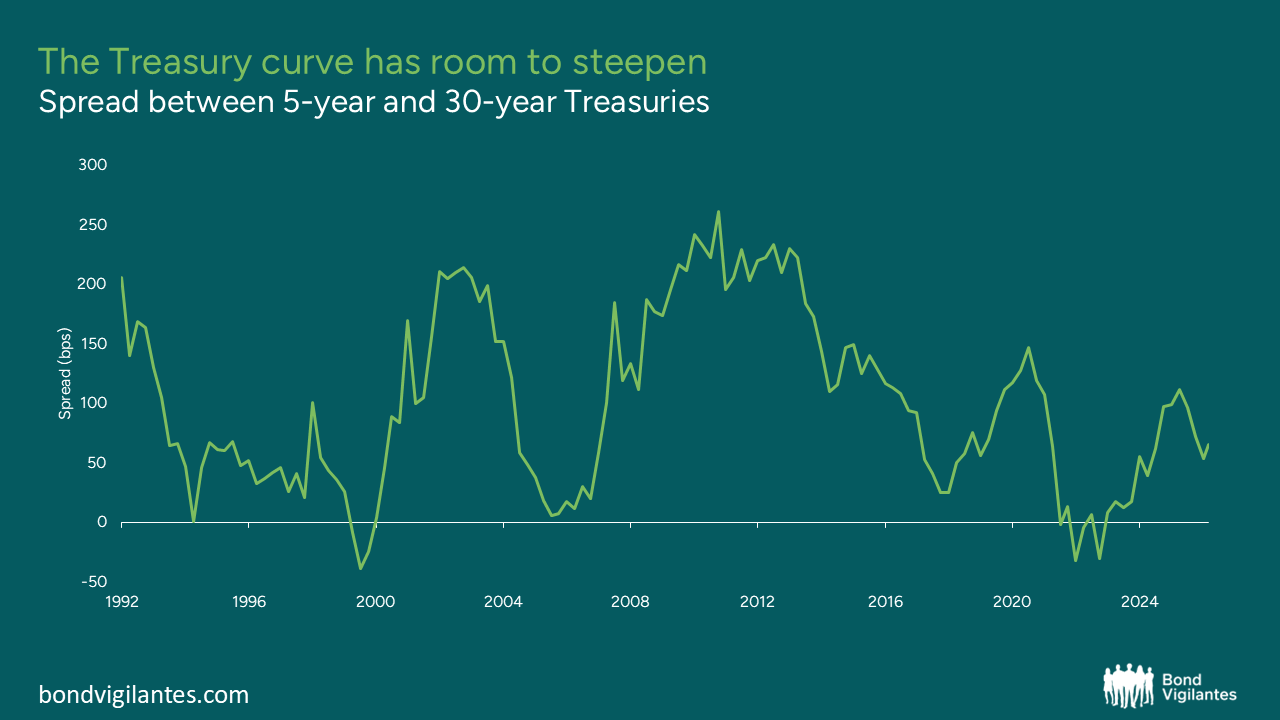
Source: Bloomberg, November 2026
The limits of insurance
None of this means a recession automatically turns into a sovereign debt problem. A genuinely deflationary downturn should still be good for government bonds, while stronger productivity or a more credible fiscal response could improve the picture. There will also be considerable differences between countries.
But neither does it guarantee an indiscriminate bond rally. Years of intervention may have encouraged investors to assume that economic weakness brings public support and lower yields throughout the curve. That assumption becomes less comfortable when the support itself requires borrowing on an already strained balance-sheet.
The value of investments will fluctuate, which will cause prices to fall as well as rise and you may not get back the original amount you invested. Past performance is not a guide to future performance.