


Le choix français

The last time European governments faced a financing challenge was 2012. It was resolved through a combination of political will, central bank action and fiscal discipline. That option is still available to the latest European government to find itself in difficulty.
What were the consequences?
The governments that faced the problem have all come out the other side, but their populations paid for it. Greek real GDP fell by more than a quarter from its 2008 peak and is still around 13% below it today. Portugal and Spain each lost close to a tenth of output. Italy did not get back to its 2008 level until 2022.
The payoff, however, was that borrowing costs came back down, and the combination of reform and central bank support is what allowed those countries to refinance at rates they could live with.
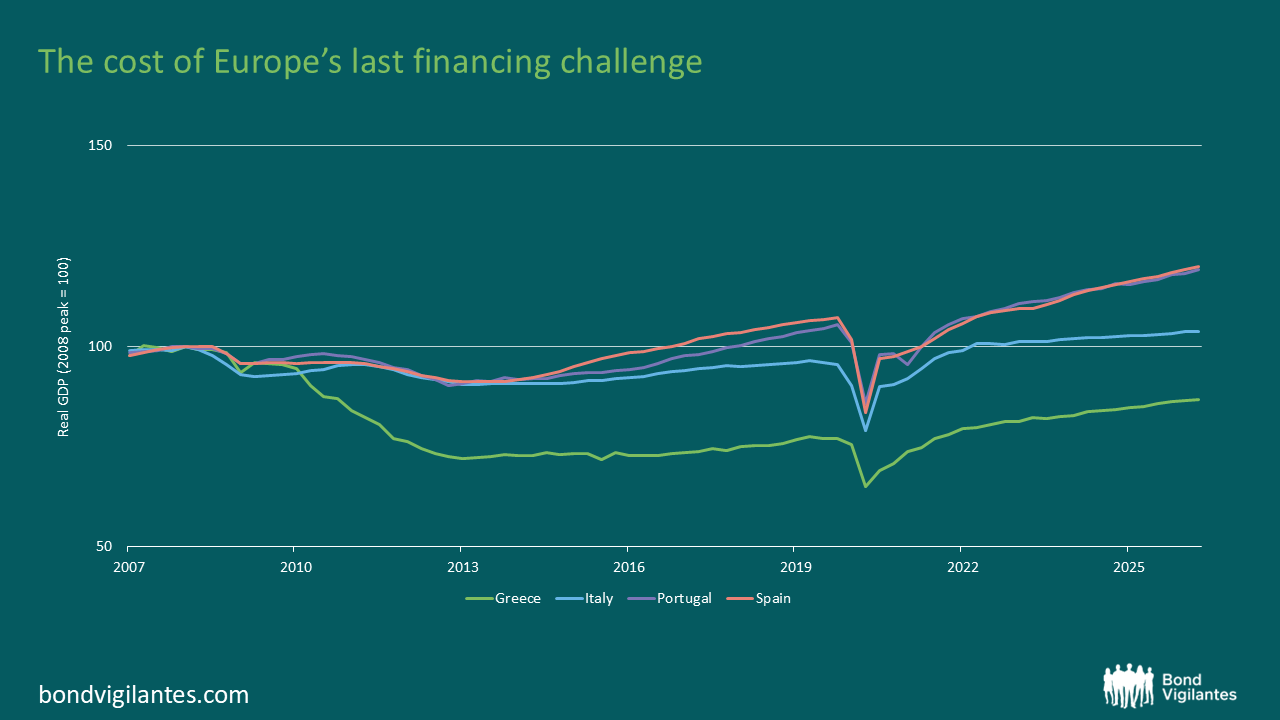
Source: M&G, Bloomberg. October 2026.
Over time, this led to a recovery in sovereign ratings. A rather painful solution, but the correct one for a better long-term outcome.
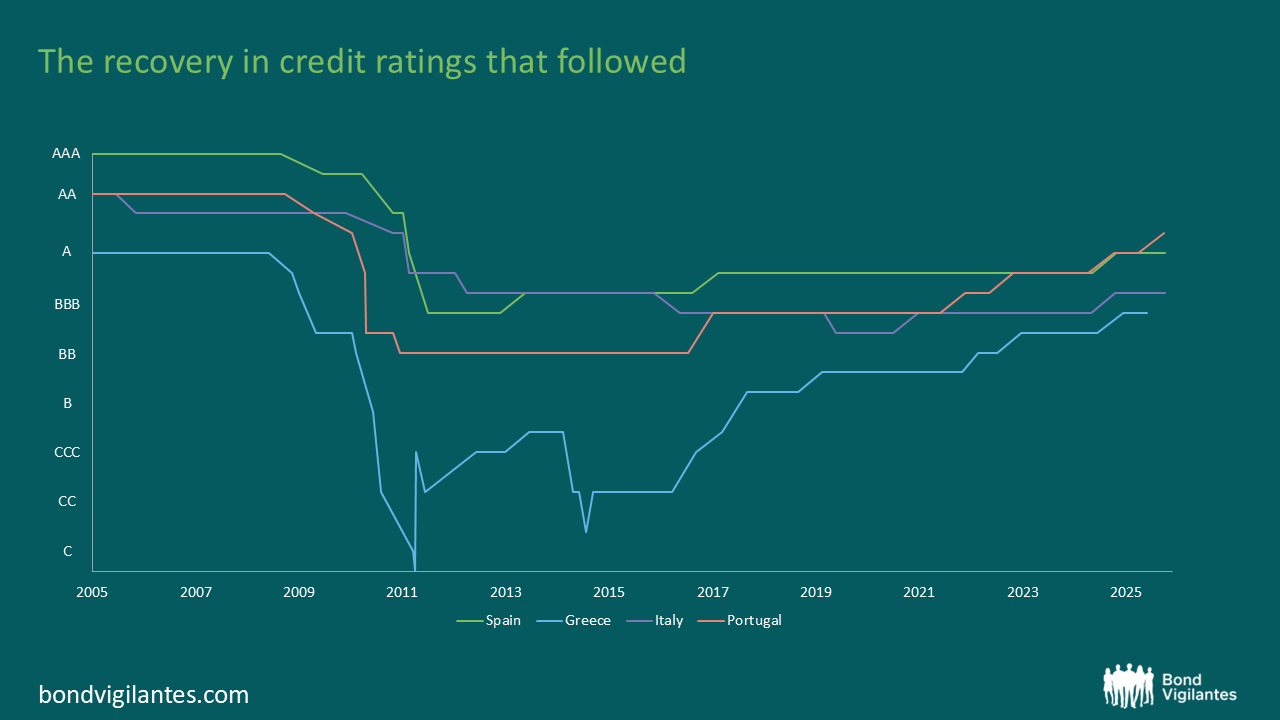
Source: Fitch Ratings, October 2026
Given the size of France, the common view is that a similar resolution is off the table. However, this should not necessarily be the case. Taken together, the above countries were 31% of euro area GDP in 2011, and France today is 18%. Europe has dealt with a bigger problem before.
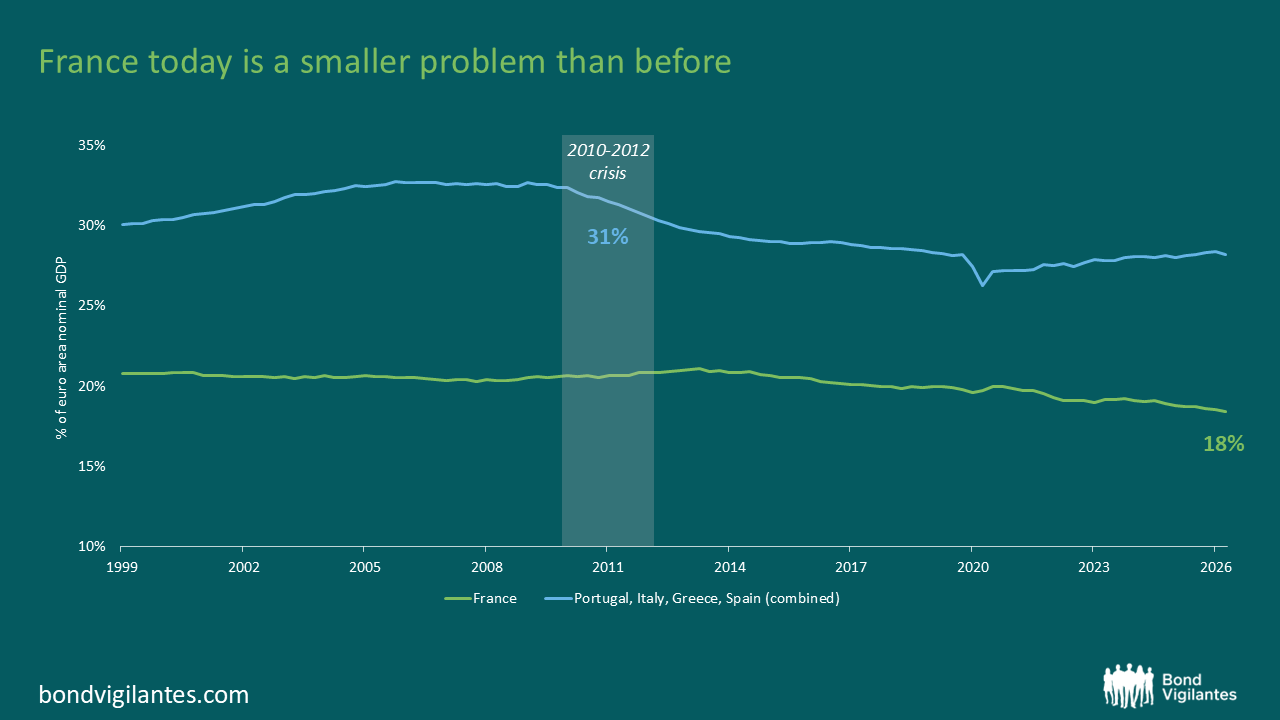
Source: M&G, Bloomberg. October 2026.
Today’s question is less whether France could take the medicine than whether it would. The latest budget finds €54bn of savings and yet still only brings the deficit down from 5.4% to 5.0% of GDP, on growth assumptions that France’s own fiscal watchdog considers optimistic.
Holding debt steady at today’s yields would need a primary surplus of a little over 2% of GDP, and France’s best five year average since 1995 is below 1%.
Then there is the 2027 presidential election, where a National Rally win can’t be ruled out and Mélenchon, from the other end of the spectrum, has already floated cancelling French government debt altogether.
Realistically, no government wants to default, and having to repay is what makes the solution of ‘Pain Inflicted, Get Stronger’ the logical one, painful as it was.
The ECB was a big part of the 2012 resolution, but support is conditional and for a country with a deficit still at 5% and a budget built on optimistic growth, France would not necessarily be an obvious candidate. If another country in the euro area got into difficulty but had its fiscal house in order, the ECB could help by stepping in, but that would then leave France looking relatively more exposed – which could make the gap more stark. And, with Lagarde leaving in February, and neither of the two leading candidates to replace her French, the next president may be less inclined to give Paris the benefit of the doubt.
Time will tell how the situation develops from here. The ‘Pain Inflicted, Get Stronger’ (PIGS) route is the logical solution, but it means working through the pain. If French politics won’t accept that route to getting stronger, then perhaps the alternative is FROGS: a French Restructuring Of Government Securities.
The value of investments will fluctuate, which will cause prices to fall as well as rise and you may not get back the original amount you invested. Past performance is not a guide to future performance.